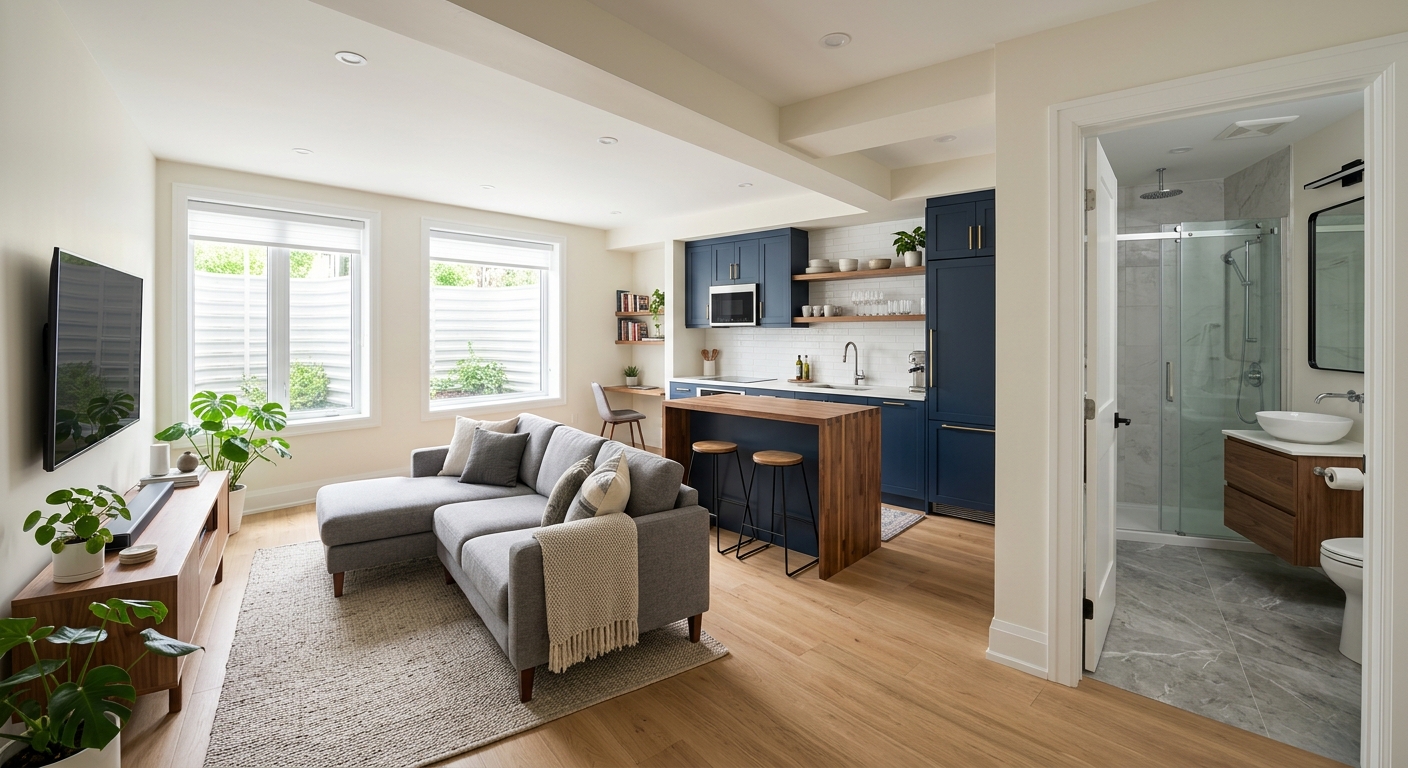
Basement finishing options and costs in Gabriola
Basement finishing in Gabriola typically starts with the realities of our island community: most homes here have full basements, and because the housing stock is largely older (and many basements have been left unfinished or only partially completed), homeowners often choose between a rec room/home office refresh or a fully legal secondary suite. With a population of about 4,500 people (Statistics Canada, 2021 Census), Gabriola is small enough that the trades workforce is limited compared with the Lower Mainland hubs—so scheduling and lead times can affect your total project budget.
Costs in the Lower Mainland–Southwest are driven by climate, code and suite demand. Coastal BC’s milder winters are paired with higher moisture exposure, so contractors prioritize waterproofing, drainage details, and mould prevention before drywall goes up. At the same time, suite demand in the broader region keeps permitting and secondary-suite labour at the upper end of Canadian ranges, which is why a “simple” plan can still land in the mid-five-figure territory when bathrooms, electrical, or fire separation are involved.
On Gabriola, trades demand is often strongest around the Departure Bay–style beachfront and older-core pockets where foundations and drainage conditions vary from lot to lot, making moisture-mitigation choices (and the amount of discovery work) more important. The next table compares typical scopes so you can line up apples-to-apples when you request quotes.
| Scope |
What's Included |
Permit Required |
Price Range |
| Basic rec room finish (drywall + lighting) |
Insulation where applicable, vapour-control approach for below-grade walls, drywall, ceiling finish, basic flooring, pot lights, trim, and final paint |
Usually no if no new plumbing/electrical/bedrooms are added (confirm with your contractor) |
$15,000–$28,000 |
| Home office finish |
Dedicated circuits planning allowance, insulation and drywall, dedicated outlets, door/trim, flooring, paint, and basic lighting |
Often yes for new electrical circuits; otherwise may be minor-work dependent |
$22,000–$40,000 |
| Full legal secondary suite (bath + kitchen + egress) |
Full build-out including kitchen/bath finishes, code-compliant fire separation approach, ventilation/dehumidification strategy, bathroom rough-ins/finishes, electrical distribution, and egress provision |
Yes (suite work, sleeping rooms, plumbing/electrical changes, and egress) |
$60,000–$140,000 |
| Egress window installation only |
Concrete foundation saw-cut allowance, window installation, grading/landscaping touch-ups, and framing to suit the opening |
Yes if it creates/changes a sleeping room or habitable requirement (confirm scope) |
$5,000–$12,000 |
| Partial finish — framing and rough-in only |
Framing, vapour strategy to match the assembly, insulation prep, rough-in plumbing/electrical set-up (where included), and prep for drywall and finishes |
Often yes when plumbing/electrical or suite components are involved |
$15,000–$35,000 |
| Luxury media or wet bar finish |
Acoustic or enhanced insulation strategy, custom ceiling bulkheads, built-in cabinetry, higher-end flooring/finishes, upgraded lighting and electrical, and wet bar rough-in/finishes |
Usually yes if wet bar plumbing or upgraded electrical scope is added |
$45,000–$80,000 |
Prices are estimates only and vary by project scope, site access and material selection.
What affects the price of basement finishing in Gabriola
In Gabriola and across the Lower Mainland–Southwest, quotes for the same “finished basement” can vary by 30–50% because moisture control requirements, code scope, and suite-driven labour costs are highly sensitive to the details of your foundation, ceilings, and how you intend to use the space. Contractors may also price uncertainty differently—especially once they find cracks, higher slab moisture, or foundation drainage issues that must be addressed before framing and drywall.
Moisture and thermal requirements are the biggest reason regional pricing diverges. Ontario and Alberta basements often face deep cold and frost heave, so assemblies commonly demand thicker exterior-grade insulation, robust vapour barriers, and engineered drainage before framing. Coastal BC is milder but wetter, so the cost emphasis shifts toward waterproofing, crack/foundation leak mitigation, mould prevention, and correct ventilation/dehumidification—meaning you can’t cut corners on the “invisible” work and expect the same outcome.
Suite demand also changes the math. Secondary suites can have ROI windows that look attractive in expensive urban markets like Toronto and Vancouver, which is why permits, inspection effort, and secondary-suite trades are priced at the upper end. In Gabriola, that same suite-driven scope (fire separation, egress, plumbing, and electrical distribution) typically pushes a project into the $60,000–$140,000 range rather than a simpler $35,000–$80,000 full basement finish.
Two concrete Gabriola examples that often raise costs: (1) an interior dehumidification/vent strategy and surface drainage correction after discovery, and (2) additional insulation depth when ceiling clearances are tight due to ducts or beams. On the lower end, cost drops when the basement is already dry, slab moisture is acceptable for flooring type, and you’re doing a rec room finish without a bathroom or dedicated circuits.
| Price Factor |
Why It Matters |
Cost Impact |
| Finishing scope — rec room vs. full suite |
Bathrooms, kitchens, fire separation and extra electrical/plumbing drive labour and inspections |
Largest swing; can move you from ~$15,000–$35,000 into ~$60,000–$140,000 |
| Egress window required |
Cutting into a concrete foundation and building the opening safely adds structure and water-management work |
Typically ~$5,000–$12,000 for the installation-only portion |
| Bathroom addition |
Rough-in plumbing, waterproofing systems, and wet-area tile require proper detailing below grade |
Commonly a mid project add-on that pushes costs toward the upper full-finish band |
| Electrical circuits |
Dedicated circuits, panel work, and code-compliant lighting/outlets increase time and materials |
Often meaningfully increases “basic finish” quotes; impacts both suite and office builds |
| Insulation and vapour barrier |
In coastal BC, assemblies must manage moisture safely; incorrect assemblies can lead to mould and rework |
Can add several thousand dollars compared with “drywall-only” budgets |
| Flooring |
Below-grade floors need systems that tolerate moisture; waterproof LVP is commonly recommended |
Material choice can shift costs moderately, plus labour for prep |
| Ceiling height |
Bulkheads around ducts/beams reduce usable height and may require redesign of HVAC/vent paths |
Can increase framing/finishing labour and limit layout efficiency |
| Permit and inspection fees |
Secondary suites typically add multiple inspection steps and documentation requirements |
Raises total overhead, pushing suite work toward the higher bands |
Permits & regulations in British Columbia
In British Columbia, basement finishing that adds a sleeping room, bathroom, new electrical circuits, plumbing rough-in, or creates a secondary suite generally requires a building permit. If you’re planning a habitable space below grade, egress windows are required for any sleeping area—meaning window installation and related framing details aren’t optional if the room is intended to be used as a bedroom. Secondary suite rules can vary by municipality, so you’ll need to confirm zoning and the expected fire-separation approach (often in the 30–45 minute range between suites, depending on the design and requirements) with the local authority before starting. Electrical work also typically requires separate permits and inspections from the building permit, and it must be done by a licensed electrician. Plumbing work likewise requires a licensed plumber and a permit in most municipalities.
What DOES require a permit (typical examples): new circuits and lighting plans that require new wiring, adding or relocating plumbing for a bathroom/kitchen, building a suite layout, and creating sleeping rooms with code-compliant egress. What typically does NOT always require a permit: purely cosmetic work like paint, trim, and reinstalling existing non-structural finishes—though if your scope includes changes to wiring, ducts, or load-bearing elements, treat it as permit territory.
To verify a contractor in Gabriola, check the BC licence status using the provincial online registry (trade type matters), request a certificate of insurance showing liability coverage, and confirm workers are covered through the proper WCB/WSIB-equivalent coverage for their trade. Ask for a clearance letter or proof of account status, and keep copies with your contract.
Basement suite vs rec room — what makes sense in Gabriola?
Most homeowners in Gabriola end up choosing between two common basement-finishing paths: a legal secondary suite or a rec room/home office. A legal secondary suite is the higher-cost option because it requires a building permit, code-compliant egress window(s) for each sleeping room, a full bathroom, kitchenette, proper ventilation/dehumidification strategy, and fire separation between the suite and other parts of the home. Many plans also include separate entrance considerations, plus the electrical and plumbing scope needed to support a rental-ready layout. In contrast, a rec room or home office can be significantly less expensive and faster because it typically avoids egress requirements unless you’re adding a bedroom, and it usually needs less plumbing and fewer high-scope electrical changes.
Because Gabriola is within the Lower Mainland–Southwest market context, suite projects are influenced by the same regional realities: the closer you get to full code-compliance details (bathroom, kitchen, fire separation, egress), the more your schedule and labour costs resemble the higher end of the $60,000–$140,000 suite band. A rec room is more likely to fall in the $15,000–$35,000 or $35,000–$80,000 full-finish territory depending on finishes and scope.
Here’s a practical dollar example: if you price a rec room upgrade and then add a bathroom plus a kitchenette, the incremental cost often justifies itself only if you’re genuinely planning to rent. If you’re using the space long-term (home office, hobby room, guest space without a bedroom), the money can be better spent on moisture-mitigation upgrades and flooring comfort instead of suite-grade build-outs.
In Gabriola’s climate, the “suite vs rec room” decision still comes down to moisture management first: waterproofing/drainage and air quality planning are not optional for below-grade spaces. If you want rental income, you’ll also want to confirm zoning—because not all municipalities allow secondary suites—even when the basement is physically suited to conversion.
| Option |
Typical Cost |
Permit Needed |
ROI Potential |
Best For |
| Rec room (basic finish) |
$15,000–$28,000 |
Usually depends; often no if no plumbing/electrical/bedroom changes |
Low (lifestyle value more than rent) |
Families adding space without a bedroom |
| Home office (dedicated space) |
$22,000–$40,000 |
Often yes for new circuits/outlets if added |
Low to moderate (work-from-home value) |
Quiet workspace with reliable power and lighting |
| Legal secondary suite (full rental unit) |
$60,000–$140,000 |
Yes (suite build-out, sleeping rooms, egress, plumbing/electrical) |
Moderate to high (rental income can help recover costs over time) |
Owners willing to manage tenants and meet code scope |
| In-law / nanny suite (non-rental) |
$45,000–$95,000 |
Commonly yes if adding plumbing/electrical and habitable sleeping rooms |
Moderate (cost avoidance more than rent) |
Multi-generational living with separate functionality |
| Media / entertainment room |
$28,000–$80,000 |
Often yes if wet bar/plumbing or major electrical upgrades are included |
Low to moderate (enhanced livability) |
Home theatre with controlled lighting and comfort |
| Home gym |
$20,000–$55,000 |
Usually depends; permit more likely with electrical upgrades |
Low (health/lifestyle value) |
Sound control, durable flooring, and resilient moisture control |
How to choose a basement finishing contractor in Gabriola
Start by verifying the contractor’s British Columbia trade qualifications and compliance. In practice, that means: confirming the relevant trade licences are valid (for example, electrician/plumber credentials where applicable), requesting certificate(s) of liability insurance that match the project value, and confirming workers’ compensation coverage (WCB) and proof—often via a clearance letter or account verification—so you’re not exposed if there’s an on-site incident. A reputable contractor won’t hesitate to provide documentation before you sign.
Next, get 2–3 itemised written quotes. Look for a labour-and-materials breakdown rather than a single lump sum—especially for insulation assemblies, waterproofing/moisture mitigation provisions, electrical fixtures/pot lights, and flooring underlay and prep. Read the scope carefully: what’s excluded (demo, waste disposal, minor concrete patching, duct modifications, paint coats)? Is permit pulling included, or is that your responsibility? Disposal and site protection are frequently where “cheap” bids disappear.
Warranty matters too. Ask for the workmanship warranty length and whether product/manufacturer warranties transfer to you after completion. Payment schedules should be conservative: never pay more than about 10–15% upfront, and hold back a meaningful amount until the work is complete and deficiencies are addressed. Also insist on a written start date and completion estimate—basement projects in the coastal climate can slip if moisture discovery requires added work.
- Confirm the correct BC licence category for each trade involved (electrician/plumber where relevant).
- Request certificate(s) of insurance and verify coverage dates and limits.
- Ask for proof of WCB coverage (or a clearance letter) before work starts.
- Get itemised quotes (labour + materials) for insulation, drywall, electrical, plumbing rough-in, and flooring prep.
- Require a written scope that lists exclusions (demo, disposal, patching, and rework allowances).
- Ask who pulls the permits and who pays inspection fees; get the plan in writing.
- Confirm moisture approach in writing (vapour control, ventilation/dehumidification, and any waterproofing details).
- Verify egress/window scope if a sleeping room is planned (what’s included vs “allowance” only).
- Check ceiling/duct bulkhead plan for usability and code clearance.
- Review finish selections with sample specs and allowance amounts to avoid “upgrade bill shock.”
- Ask for a workmanship warranty and whether manufacturer warranties apply to your installed products.
- Use a payment schedule that limits upfront payment and holds retainage until close-out.
Red flags in Gabriola: contractors who won’t show proof of insurance/WCB coverage, “lump-sum only” bids without moisture and assembly details, vague scope language around waterproofing/moisture control, promises to skip permits for suite-related or electrical/plumbing work, and schedules that don’t account for discovery/remediation delays common in below-grade work.
Frequently asked questions — basement finishing in Gabriola
How much does a basement suite cost in Gabriola?
In Gabriola, a legal secondary suite typically lands in the $60,000–$140,000 range, depending on how much plumbing/electrical work is required, how many bathrooms you’re adding, and whether you need egress windows for each sleeping room. Coastal BC’s wetter conditions also affect budgeting because moisture control and ventilation are part of “proper finishing,” not optional extras. If your suite plan includes a new bathroom and a kitchenette, expect the higher end of the band. If you’re converting an already-dry, already-partially-finished basement with straightforward layouts, the cost can be closer to the lower end. Always compare quotes with an itemised scope so you’re not paying later for missing waterproofing or rough-in work.
What insulation do I need for a basement in Gabriola's climate?
For Gabriola basements, insulation choices should be based on your wall assembly and moisture strategy, not just thickness. Coastal BC pushes the priority toward assemblies that manage moisture safely while still meeting thermal performance requirements—meaning your contractor should specify the insulation type and the vapour-control/air-sealing approach as one system. In practice, we often see insulated stud walls or insulated assemblies paired with a vapour-control layer and careful detailing around rim joists and penetrations. If you’re finishing a suite or adding bedrooms, the insulation and air-sealing become even more important for comfort and to reduce condensation risk. A good contractor will explain how their approach prevents dampness behind drywall rather than only quoting an insulation R-value.
Do I need a vapour barrier in my Gabriola basement?
In many below-grade assemblies in British Columbia, you’ll need a vapour-control strategy, but the “type and placement” must match your wall system and moisture conditions. Coastal BC’s wet climate means condensation risk can show up if assemblies are built incorrectly—so it’s not just about slapping on a generic barrier. A proper approach typically involves air-sealing first (to stop warm, moist air from migrating), then using an appropriate vapour-control layer and correct assembly detailing. If you already have insulation and a vapour-control layer, the question becomes whether it’s compatible with the existing wall conditions and whether it was installed correctly. Your contractor should be able to describe the assembly and provide details you can verify during the build.
What flooring is best for a finished basement in Gabriola?
For Gabriola, the “best” flooring is the one that tolerates below-grade moisture and makes maintenance realistic. Waterproof LVP is commonly recommended because it handles small amounts of moisture and is easier to replace sectionally if needed. Over any below-grade substrate, proper prep is critical: the floor must be level, clean, and dry enough for your chosen system. If your concrete slab has moisture issues, your contractor may recommend a moisture-mitigation approach before installing finish flooring. Avoid choosing the lowest-cost material without discussing slab moisture and underlay compatibility—because rework can erase initial savings quickly. When comparing quotes, ask what flooring system they’re including (product type, underlay, and prep) rather than just the flooring brand or a vague allowance.
How do I prevent moisture problems in a finished Gabriola basement?
Moisture prevention in Gabriola is usually won or lost before drywall goes up. Coastal BC basements benefit from a moisture plan that often includes (1) inspecting drainage pathways and foundation cracks, (2) addressing any water entry routes, (3) using the correct vapour-control approach and air-sealing to limit condensation, and (4) incorporating ventilation/dehumidification strategies so the space stays dry year-round. If a slab is damp or a foundation shows active seepage, the project scope may shift toward remediation and waterproofing before finishes. A good contractor will also protect ducts and electrical penetrations, and they’ll think about how humidity is managed after the space is insulated and sealed. Ask what they do when moisture is discovered during demo—what’s their step-by-step plan and budget allowance?
What is the ROI on finishing a basement in Gabriola?
ROI depends on whether you’re adding a revenue-capable space (suite) or purely increasing usable living space (rec room/office). In many Canadian markets, suite ROI can be stronger because rental income helps recover costs, and in the wider Lower Mainland context secondary-suite demand can support financing logic. However, Gabriola-specific ROI still depends on zoning approval, permit timelines, and what rent you can realistically achieve locally. A rec room or home office generally offers lifestyle ROI and can support resale value, but it typically won’t generate immediate cash flow. If you’re choosing between a simple finish in the $35,000–$80,000 band and a full legal suite around $60,000–$140,000, the decision should be based on your ability to rent and the cost of meeting egress, bathroom/kitchen, and fire-separation scope—not just the “what if” income scenario.