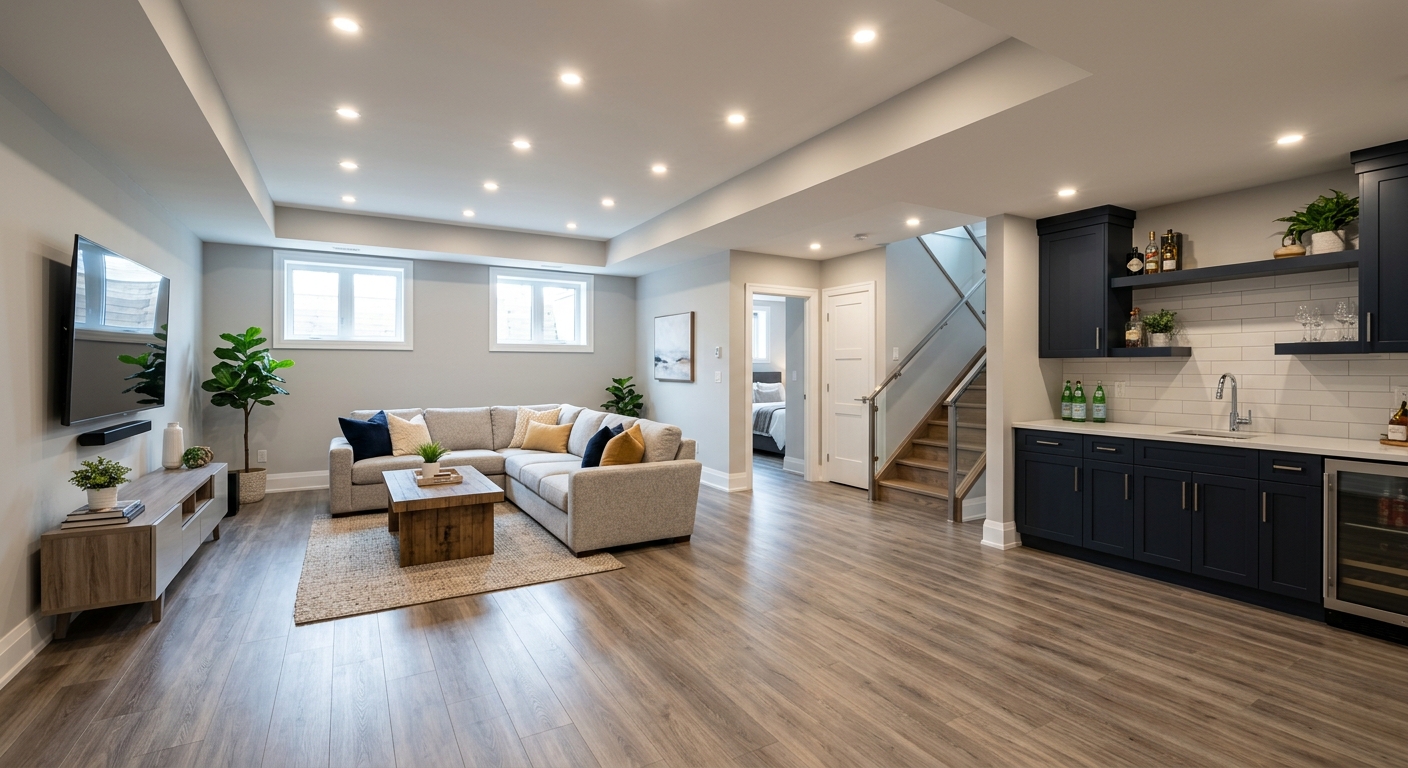
Basement finishing options and costs in Ganges
In Ganges, you’ll typically find basements tied to older single-detached housing stock, and with a city population around 6,000 (Statistics Canada, 2021 Census), contractor schedules often run through peak “spring-to-fall” demand rather than year-round. Most detached homes in the Ganges area have full or mostly full basements, but many start out unfinished or only partially finished—so the decision is usually about how much space to make usable and how aggressively to manage moisture. In the Lower Mainland–Southwest market, that choice is shaped by a wet coastal climate (more crawl/relative humidity problems than hard frost) plus high suite demand in the region, which keeps trades busy and can push labour and inspection costs toward the upper end of Canadian ranges.
Coastal BC projects often require interior and foundation moisture control, careful vapour barrier detailing, and dehumidification planning before insulation and drywall go in. That sequencing is one reason two contractors can price the “same” room differently: one includes drainage/waterproofing checks and the other treats moisture as an afterthought. In Ganges, this work is especially in demand around the Fernhill and Basin View areas, where homeowners commonly upgrade older foundations for comfort and, for some, rental flexibility.
Below are the typical options homeowners compare—starting with simple dry finishes and moving up to legal suite work that includes egress and fire separation—followed by realistic budget bands for Ganges.
| Scope |
What's Included |
Permit Required |
Price Range |
| Basic rec room finish (drywall, flooring, pot lights) |
Drywall over existing framing, insulation check where required, LVP or laminate, ceiling grid/tidy soffit as needed, taped/painted walls, basic electrical allowance (pot lights/outlets), trim and doors |
Usually not for finishing only; confirm if adding electrical circuits beyond minor changes |
$15,000–$28,000 |
| Home office finish (insulation, drywall, dedicated circuits) |
Insulation where wall cavities allow, vapour barrier detailing, drywall/taping/paint, office-grade outlets and dedicated circuit allowance, acoustic-minded sealing, flooring and trim |
Often required if electrical work includes new/modified circuits |
$20,000–$40,000 |
| Full legal secondary suite (bath, kitchen, egress, fire separation) |
Kitchen + bathroom rough-in and finishes, insulation upgrade, 2nd unit ceiling/fire separation detailing, dedicated electrical/panel planning, egress windows, ventilation/dehumidification plan, interior doors and trim, code-compliant life safety items |
Yes—secondary suite typically requires building permit and multiple inspections |
$60,000–$140,000 |
| Egress window installation only |
Core drilling/break-out as required, window supply/install, grading/drainage attention around the well, waterproofing tie-ins, structural detailing allowance |
Yes—adding an egress opening for a sleeping area is permitted work |
$5,000–$12,000 |
| Partial finish — framing and rough-in only |
New/modified framing, insulation/vapour barrier prep, electrical rough-in allowance, plumbing rough-in allowance if indicated, subfloor prep, inspections readiness |
Yes—rough-in and framing typically require permits/inspections |
$18,000–$35,000 |
| Luxury media or wet bar finish |
Sound-sealed walls, theatre-style ceiling/soffits, feature lighting, custom built-in bar cabinetry, waterproof sink rough-in allowance, specialty flooring, trim package |
Yes if adding plumbing/electrical beyond minor work; confirm suite fire/life safety implications if relevant |
$30,000–$80,000 |
Prices are estimates only and vary by project scope, site access and material selection.
What affects the price of basement finishing in Ganges
In Ganges and across the Lower Mainland–Southwest region, it’s common to see quotes for the “same” basement finish come in 30–50% apart—mainly because moisture control, electrical scope, and code requirements aren’t optional in coastal BC. One contractor prices to build for an interior dehumidified environment; another only prices for cosmetics. Also, in higher-demand markets, labour availability and permitting/inspection overhead can sit at the upper end, similar to how large-city rental pressure changes trade pricing elsewhere.
Moisture and thermal requirements drive the biggest swings between regions, and coastal BC changes the priorities. Ontario and Alberta basements often need robust exterior-grade insulation and vapour barrier strategies to manage deep winter cold and frost-heave risk, while coastal BC’s milder but wetter conditions push you toward waterproofing tie-ins, interior drainage checks, crack evaluation, and mould prevention (often with more attention to vapour control at the right locations). In practical terms, a bathroom addition in a damp-prone basement costs more when the quote includes membrane detailing, subfloor prep, and ventilation—not just tile and vanity.
Local market demand matters too: where secondary suites are feasible, the cost of permits, fire separation detailing, and egress window work can be justified by rental income, which is why suite budgets often align with the basement suite/secondary unit band ($60,000–$140,000). If you’re staying in the rec-room/home-office lane, many projects land closer to partial/full finishing bands ($35,000–$80,000 for a full basement renovation), with less structural complexity and fewer life-safety items.
Two concrete Ganges examples: (1) if your foundation shows active seepage or recurring humidity, adding drainage and waterproofing before framing can add weeks and meaningful cost, but it prevents rework; (2) if you need an egress window, cutting the foundation typically triggers structural and waterproofing tie-ins, often moving the project into the higher end of the $5,000–$12,000 egress range. Older home age also matters—older foundations may have cracks or membrane conditions that change how insulation and vapour control can be safely installed.
| Price Factor |
Why It Matters |
Cost Impact |
| Finishing scope — rec room vs. full suite (biggest variable) |
Suites add plumbing, kitchen, fire separations, more electrical, and life-safety items |
$20,000–$100,000+ spread on comparable basements |
| Egress window required |
Cutting concrete and creating safe access well geometry adds labour, waterproofing tie-ins, and sometimes structural detailing |
$5,000–$12,000 line item impact |
| Bathroom addition |
Rough-in plumbing, venting, subfloor waterproofing, and wet-area tile work are labour- and material-intensive |
$10,000–$30,000+ depending on layout and finishes |
| Electrical circuits |
Dedicated circuits/panel allocation, pot lights, and code-compliant outlets increase electrician time and inspection requirements |
$3,000–$15,000+ (often more with kitchens/suites) |
| Insulation and vapour barrier |
Below-grade assemblies in coastal BC need moisture-smart vapour control and correct insulation depth to avoid condensation risk |
$2,500–$12,000 depending on wall conditions |
| Flooring |
Waterproof LVP and robust subfloor prep reduce long-term call-backs in a wetter climate |
$1,500–$8,000+ for prep and materials |
| Ceiling height |
Bulkheads around ducts/beams and thicker assemblies reduce headroom and can force reconfiguration of ductwork/lighting |
$1,000–$6,000+ to redesign and rebuild |
| Permit and inspection fees |
Suite work generally triggers multiple inspections and additional admin time; complexity affects contractor admin costs |
$2,000–$8,000+ typical suite-driven overhead range |
Permits & regulations in British Columbia
In British Columbia, adding finishing work to a basement can be “permit or no permit,” but it hinges on what you’re changing—not whether the project looks finished. Generally, any basement finishing that adds a sleeping room, a bathroom, new electrical circuits, plumbing rough-in, or creates a secondary suite requires a building permit. If you’re creating a habitable sleeping area below grade, an egress window is mandatory for life safety. Secondary suite regulations vary by municipality, so you need to confirm zoning and the expected fire separation between dwelling units (commonly in the 30–45 minute range, depending on the assembly and how the municipality interprets the project) before you start demolition.
Work that typically DOES require a permit in BC includes: framing changes that alter occupancy, electrical upgrades beyond minor work, plumbing/venting for a bathroom or kitchen, installing an egress window, and building a second dwelling unit. Work that often does NOT require a permit is limited to cosmetic finishing where you are not adding electrical circuits, not adding plumbing, and not creating new sleeping rooms (for example, painting, replacing trim, or installing carpet/LVP over existing, dry subfloors—though you should still confirm with your contractor and local authority).
Step-by-step for hiring safely in Ganges: 1) Ask for the contractor’s licence details and verify through the appropriate BC registry for their trade category. 2) Request a current certificate of insurance (general liability) showing your project address or coverage and ask for the effective dates. 3) Confirm coverage for workers under WSIB/WCB equivalents for the trade—your contractor should provide clearance/coverage documentation or proof on request. 4) Get everything in writing: permit responsibility, inspection schedule, and which licensed subcontractors (electrician/plumber) will be used.
Basement suite vs rec room — what makes sense in Ganges?
In Ganges, the two most common basement-finishing paths are a legal secondary suite and a rec room/home office. Choosing between them comes down to how much life-safety and compliance you’re willing to build in—and whether you want rental income to offset the bigger upfront cost.
1) Legal secondary suite typically means an egress window in each sleeping room, a full bathroom, a kitchenette (where allowed), and a separate entrance plan. You’ll also need the fire separation work and a building permit, plus inspections. The upside is rental income potential, and in the Lower Mainland–Southwest, where housing costs and rental demand strain budgets, that ROI can be decisive for homeowners who can carry a longer payback period. Suite approvals also mean planning for a clear timeline—often staged inspections—rather than a single smooth finish.
2) Rec room or home office is usually faster and cheaper because you avoid the suite infrastructure (and often avoid egress unless you’re adding a bedroom). You still need to manage moisture properly in a coastal climate, but you typically don’t need full kitchen plumbing or the same extent of fire/life-safety detailing.
Here’s where the price difference can make sense (or not). A basic rec room finish might fit the $35,000–$80,000 full-basement band when it’s extensive, while a legal secondary suite often lands in the $60,000–$140,000 range because of plumbing, electrical, egress, and permit/inspection overhead. If you’ll live in the home for years and value a flexible space, a rec room can be the right ROI. If you’re targeting rental income to help with mortgage pressure, the suite path can justify the additional cost—provided the municipality/zoning allows it and your basement meets egress and separation requirements.
Weather and building-envelope realities in Ganges matter here too: wet coastal conditions mean vapour control and ventilation/dehumidification planning are critical for either option, but the suite case adds more rooms/occupancy and therefore more reasons to design it for stable indoor humidity.
| Option |
Typical Cost |
Permit Needed |
ROI Potential |
Best For |
| Rec room (basic finish) |
$15,000–$28,000 |
Usually only if adding/modifying electrical circuits beyond minor changes |
Low (no rental unit) |
Families needing immediate comfort and entertainment space |
| Home office (dedicated space) |
$20,000–$40,000 |
Often if adding a dedicated electrical circuit |
Moderate (house usability/quality) |
Work-from-home households prioritizing noise control and dedicated outlets |
| Legal secondary suite (full rental unit) |
$60,000–$140,000 |
Yes—suite permit and multiple inspections |
High (rental income can help offset costs) |
Owners planning long-term and wanting income-based payback (when zoning allows) |
| In-law / nanny suite (non-rental) |
$50,000–$110,000 |
Often yes if adding sleeping area, plumbing, or egress; confirm locally |
Low to moderate (family support more than cash ROI) |
Extended family living arrangements where privacy is important |
| Media / entertainment room |
$30,000–$80,000 |
Yes if electrical scope is expanded significantly |
Low to moderate |
Homeowners wanting built-ins, upgraded lighting, and sound-smart finishes |
| Home gym |
$15,000–$35,000 |
Usually permit not needed unless adding circuits or plumbing |
Low |
Comfortable, dry space with durable flooring and moisture-safe finishes |
How to choose a basement finishing contractor in Ganges
When you hire for a basement in Ganges, licensing and insurance aren’t paperwork—they’re how you protect your home from schedule slips and rework. In British Columbia, confirm the contractor’s trade category licence (as applicable) and ask for proof of liability insurance (certificate of insurance with your project/jobsite noted if possible). For worker coverage, verify WSIB/WCB coverage documents or clearance letters where required—your contractor should be able to provide proof on request.
Next, get 2–3 itemised written quotes. You want a breakdown of labour versus materials (and allowance amounts for fixtures, flooring, and insulation), not a lump sum that hides where costs can move later. Read the scope carefully for exclusions: is waterproofing assessment included, is permit pulling included, and is debris disposal included? In coastal BC, a moisture plan should be explicit—what happens if humidity is already high, if there are signs of seepage, or if subfloor moisture readings are poor.
Warranty matters in basements: ask for the workmanship warranty length and whether it covers both building elements (taping/paint cracks, framing) and moisture-related performance (to the extent of the scope). Also ask whether product/manufacturer warranties apply directly to you and if they’re transferable.
Payment schedule: never pay more than 10–15% upfront. Hold back a portion until key milestones are complete (especially after insulation/vapour details are done and before drywall, and again at final handover). Finally, get the start date and completion estimate in writing, including whether the contractor plans inspections as part of the timeline.
- Ask for licence proof for the appropriate trade category and verify it yourself before signing.
- Request a current certificate of liability insurance and confirm coverage dates.
- Verify WSIB/WCB coverage documentation or clearance letter (ask the contractor directly).
- Insist on an itemised quote: labour, materials, and allowances separated.
- Confirm whether permits and inspections are pulled by the contractor or by you.
- Check what’s included for moisture control (vapour barrier detailing, ventilation/dehumidification plan, and water management steps).
- Ask whether disposal/dump fees are included in the quote.
- Confirm egress window responsibilities if any bedrooms are contemplated (who measures, who waterproofs tie-ins).
- Get electrical and plumbing details in writing: number of circuits, fixture counts, and rough-in allowances.
- Ask for a detailed change-order process and how pricing will be handled if conditions differ.
- Request a workmanship warranty in writing and clarify what events void it (e.g., homeowner moisture neglect).
- Use a payment schedule with holdbacks aligned to inspection-ready milestones.
Red flags I see with basement finishing contractors in the Ganges area: they won’t discuss moisture control before framing; they provide only a vague “finished basement” lump sum; they avoid written scope for permits and inspections; they ask for large upfront deposits (well beyond 10–15%); or they can’t show insurance/coverage proof and recent basement project references with similar moisture conditions.
Frequently asked questions — basement finishing in Ganges
How do I add a bathroom to my Ganges basement?
In Ganges (British Columbia), adding a bathroom usually triggers permit requirements because you’re adding plumbing work and wet-area finishing. Plan for more than just tile: your contractor should account for venting, supply/fixture placement, and subfloor waterproofing suitable for below-grade moisture conditions. In coastal BC, ventilation and humidity control are critical to preventing odours and mould around shower and tub walls. Budget-wise, the bathroom component can materially shift the project totals—commonly adding a meaningful slice to a basement renovation budget that might otherwise sit in the $35,000–$80,000 range for full finishing, or pushing you higher if you’re building a larger suite in the $60,000–$140,000 band. Ask your contractor for a plumbing rough-in plan and confirm who is pulling the permit and scheduling inspections.
What is the difference between a finished and semi-finished basement?
A semi-finished basement typically means the “big infrastructure” is in place but the space isn’t fully finished for daily living: you might see framing, insulation, and perhaps drywall in partial areas, but flooring, trim, ceiling finishing, and full electrical/lighting may be incomplete. A finished basement is fully built-out—complete drywall/paint, floor covering, proper lighting/outlets, and (where applicable) bathroom/kitchen finishes with waterproofing and code-compliant ventilation. In Ganges, the moisture-smart difference matters: finished basements still need careful vapour barrier detailing and dehumidification planning for coastal dampness. This is one reason pricing varies across the Lower Mainland–Southwest: a contractor that includes moisture assessment and sequencing will cost more than one that only prices surfaces. Even a basic finish can be budgeted around $15,000–$28,000, while full finishing typically trends toward $35,000–$80,000.
How do I soundproof a basement suite in Ganges?
Soundproofing in a basement suite in Ganges isn’t just about “thicker drywall.” You need an assembly strategy that reduces airborne noise and vibrations—especially between floors and around shared plumbing/electrical routes. Start with sealed penetrations (electric boxes, service pipes), insulation in stud cavities, and resilient channels or a staggered stud approach where feasible. For suites, fire separation detailing and sound control sometimes overlap, but you still must meet code and the municipality’s suite requirements. If you’re adding a suite, the project complexity is higher and pricing usually aligns with the suite band—often $60,000–$140,000 once you include egress, bathrooms/kitchen, and permit/inspection overhead. In coastal BC’s wetter climate, keep in mind that soundproofing shouldn’t trap moisture; ventilation/dehumidification planning is essential so the space stays dry while maintaining acoustic comfort.
How much does it cost to finish a basement in Ganges?
Cost depends on scope, moisture conditions, and whether you’re creating a bedroom/suite. For a rec room or similar partial project, many homeowners budget around $15,000–$35,000 depending on electrical scope, flooring, and ceiling work. For a more complete full-basement renovation (drywall, floors, lighting, and broader finishing), many projects land in the $35,000–$80,000 range in the Lower Mainland–Southwest. If you’re building a legal secondary suite, expect substantially higher budgets—often $60,000–$140,000—because you’re adding bathrooms/kitchen, dedicated life-safety items, and egress window work plus additional inspections. In Ganges specifically, coastal wet conditions can add cost when waterproofing assessment or moisture mitigation is required before framing. The best way to narrow your number is an itemised quote that includes how the contractor will handle moisture and what permits are included.
Do I need a permit to finish my basement in British Columbia?
In British Columbia, whether you need a permit depends on what changes you’re making. Finishing alone can sometimes be permit-light, but permits are typically required when you add a sleeping room, a bathroom, new electrical circuits, plumbing rough-in, or create/finish a secondary suite. Egress windows are mandatory for habitable sleeping areas below grade. For suite builds, regulations vary by municipality, so you should confirm zoning and the expected fire separation details with the local authority before starting. Also remember: electrical permits and inspections are separate and require a licensed electrician; plumbing work also typically requires a licensed plumber and permit. For homeowners in Ganges, a practical approach is to ask your contractor to list exactly what triggers the permit on your project scope—then confirm the contractor’s responsibility for pulling permits in writing.
How long does a basement finishing project take in Ganges?
Timelines vary, but many basement finishing projects in Ganges follow a predictable sequence: moisture assessment and any water control work first, then insulation/vapour barrier, rough-ins (electrical/plumbing), inspections, drywall/ceiling close-in, then flooring/trim and final paint and fixtures. A smaller rec room finish may take a few weeks once materials are on site, while a bathroom-including project often takes longer because plumbing rough-in and inspection can add lead time. If you’re building a secondary suite, plan for a staged schedule with additional inspections and life-safety items like egress window work and fire separation detailing—often extending the overall timeline meaningfully. Weather and trade availability also matter in coastal BC; delays can come from permitting/inspection scheduling and material lead times. To manage expectations, request a written start date and completion estimate and confirm whether inspections are included in the contractor’s schedule.