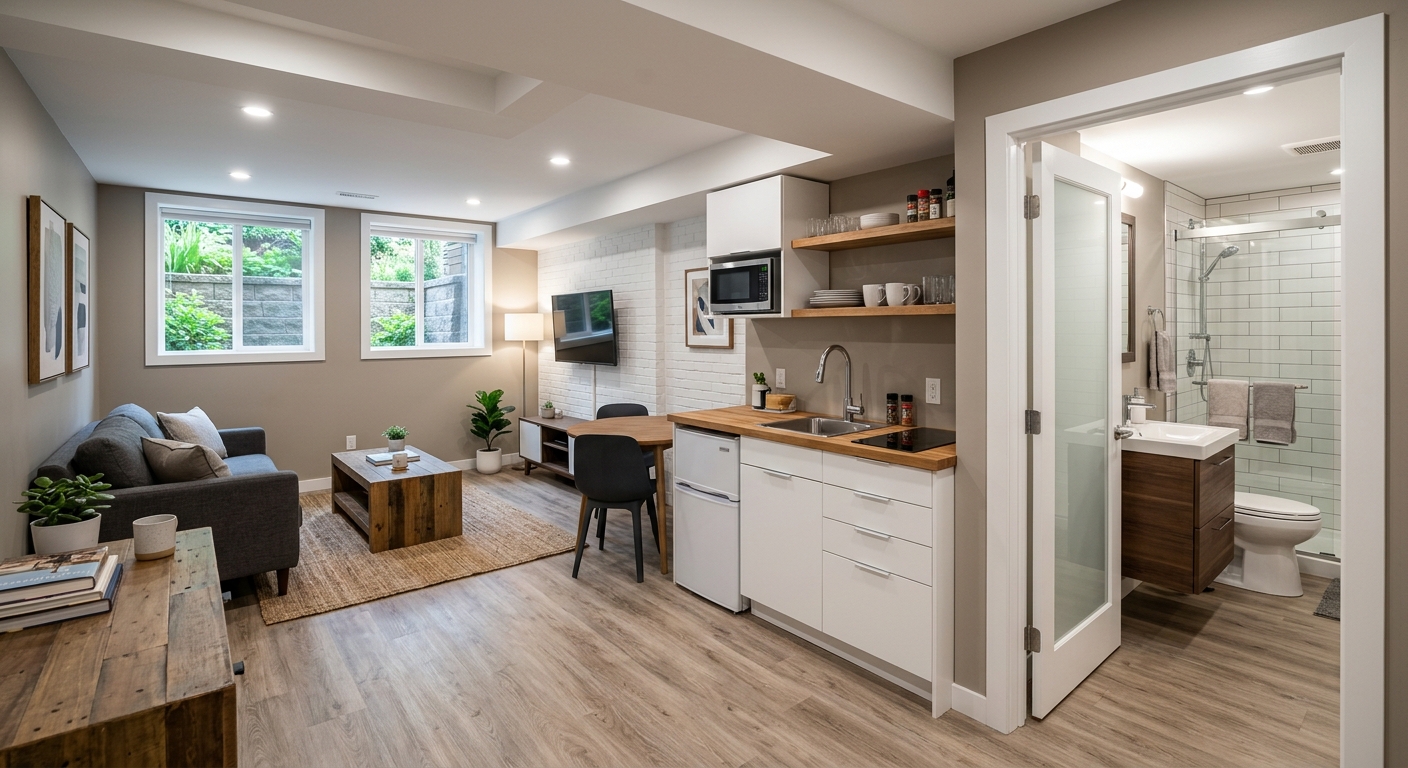
Basement finishing options and costs in Little Mountain
Basement finishing in Little Mountain is a smart way to add space, but the cost and timeline are shaped by our Lower Mainland–Southwest reality: damp conditions, code requirements for moisture control, and the ongoing pull of secondary suites. Little Mountain is a small community (population 1,170 as of the 2021 Census), and that matters because many local contractors and suppliers are pulled between scattered projects across the Lower Mainland—so lead times and scheduling can vary. Most detached homes here typically have a full basement, and in many cases that space is either unfinished or only partially finished, which is exactly where moisture-proofing steps and code-compliant assembly become the difference between “cheap” and “done right.”
In this region, quotes for the same floor plan can differ because coastal BC is milder than the Prairies but meaningfully wetter. That shifts priorities toward waterproofing, foundation crack management, and mould prevention—plus ventilation and dehumidification strategies that keep basements comfortable year-round. At the same time, secondary-suite demand in the surrounding Lower Mainland markets keeps trades pricing elevated, particularly in areas where suites are common (for example, the Sumas Mountain / Greendale corridor influences how nearby projects are priced and staffed). When labour is tight and materials must meet stricter assemblies, projects tend to land in the upper end of typical ranges.
Below is a practical cost comparison to help you budget and scope conversations before you request itemised quotes.
| Scope |
What's Included |
Permit Required |
Price Range |
| Basic rec room finish (drywall + flooring) |
Insulated ceiling/walls as needed, drywall, paint, LVP flooring, pot light electrical allowances, basic trim/doors |
Usually no, if you do not add plumbing/wet areas or new bedrooms |
$15,000–$35,000 |
| Home office finish |
Insulation upgrades (as required), drywall, sound control where feasible, dedicated circuits planning, door/trim, flooring, lighting |
Often no for finish-only, but permit may apply for new circuits/panel work |
$20,000–$45,000 |
| Full legal secondary suite |
Kitchenette, full bathroom, bedrooms with egress, fire separation details, ventilation/dehumidification, wet-area waterproofing, separate access as required |
Yes |
$60,000–$140,000 |
| Egress window installation only |
Concrete/foundation cut, window and code-compliant well/grading, drainage and sealant detailing |
Yes if tied to creating a legal sleeping area |
$5,000–$12,000 |
| Partial finish — framing and rough-in only |
Stud framing, some insulation, rough electrical/plumbing as scoped, taped/ready-to-drywall stage, blocking for future fixtures |
Often yes for rough-in work; verify with contractor and authority |
$18,000–$55,000 |
| Luxury media or wet bar finish |
Feature wall, enhanced insulation/sound treatments, built-ins, stone/quartz look surfaces (as selected), wet bar plumbing allowances, upgraded lighting scenes |
Usually no unless you add plumbing scope that triggers permits |
$35,000–$80,000 |
Prices are estimates only and vary by project scope, site access and material selection.
What affects the price of basement finishing in Little Mountain
In the Lower Mainland–Southwest, it’s common to see quotes for the “same” basement finish swing by 30–50%. The main drivers are moisture/thermal code assemblies, how much scope triggers separate trades permits (electrical and plumbing), and how suite demand affects labour availability and inspection scheduling. Even within British Columbia, regional building habits differ: in Ontario and Alberta, contractors often budget for deeper frost control and higher-risk freeze/thaw detailing, while coastal BC’s cost pressure leans more toward waterproofing, mould prevention, foundation crack management and below-grade ventilation/dehumidification. That means “insulation and drywall” is never the only cost—prep work and assemblies can be the largest line item.
In Little Mountain, two practical examples often push costs up. First, when foundation cracks or musty odours show up during demo, contractors typically need to add drainage/sealing and increase membrane attention before framing; that can move a basic rec room finish toward full basement finishing pricing. Second, if you’re adding a bathroom or kitchenette, the wet-area rough-in (including venting and waterproofing) adds both materials and labour time—often narrowing the gap between partial finishing budgets and the $35,000–$80,000 full-finish tier depending on finishes. On the flip side, costs can drop when you keep a dry storage/mechanical wall configuration and only add surface finishes (which aligns more with the $15,000–$35,000 partial/rec-room band).
Market pressures matter too. When suites are in high demand across the Lower Mainland, design/engineering and inspection coordination can cost more and take longer, which is why legal secondary suite work commonly lands near the higher $60,000–$140,000 range. Housing stock age and damp-prone basements also influence whether you’re paying for “finishing” or paying for “fixing moisture first,” and that’s where the real budget spread shows up.
| Price Factor |
Why It Matters |
Cost Impact |
| Finishing scope — rec room vs. full suite |
Suites add wet areas, fire separation details, bedrooms with egress, and more inspections |
Largest variable; can shift you from the rec-room range into suite pricing |
| Egress window required |
Cutting concrete/foundation structure and installing drainage/sealant work is labour-intensive |
Often adds several thousand dollars per opening |
| Bathroom addition |
Rough-in plumbing, venting, waterproofing, and tile-ready assemblies take time |
Commonly pushes mid-scope projects toward full basement budgets |
| Electrical circuits |
Dedicated circuits, panel work, and code lighting layout require licensed electricians and inspections |
Can add significant labour + inspection coordination costs |
| Insulation and vapour barrier |
Below-grade assemblies must manage moisture in BC’s wetter conditions and maintain code-required thermal performance |
More complex wall assemblies cost more but prevent long-term mould risk |
| Flooring |
Below-grade LVP and underlay selection must tolerate humidity and occasional moisture migration |
Moderate material premium for waterproof/compatible systems |
| Ceiling height |
Bulkheads around ducts/beams reduce usable height and can increase labour for trim and soffits |
Can reduce “finish speed” and add detailing cost |
| Permit and inspection fees |
Secondary suite projects need multiple checkpoints, and inspection sequencing affects schedule |
Higher administrative and compliance costs; can add schedule risk |
Permits & regulations in British Columbia
In British Columbia, basement finishing that adds a sleeping room, bathroom, new electrical circuits, plumbing rough-in, or a secondary suite generally requires a building permit. Egress windows are mandatory for any habitable sleeping area located below grade—so if you’re planning a bedroom, you should budget for egress early rather than after framing. Secondary suite requirements can vary by municipality, particularly around zoning and the required fire separation and ventilation strategies, so confirm details with the local authority before you start construction.
Here’s what usually does require a permit in BC: creating or finishing a new bedroom (and any related egress work), adding a bathroom or wet bar (plumbing/venting and waterproofing scope), installing new plumbing rough-ins, running new electrical circuits or modifying electrical service capacity, and building a legal secondary suite. Electrical permits/inspections are typically separate from the building permit and require a licensed electrician to pull the right permits and complete the work. Plumbing also requires a licensed plumber and—depending on scope—permits.
Step-by-step for homeowners in Little Mountain: (1) ask the contractor for their BC licence numbers and the permit plan they’ll submit; (2) verify contractor credentials using BC’s online licence/regulatory registries; (3) request a current certificate of insurance and confirm it includes liability coverage adequate for the job; and (4) ask how they handle workers’ coverage (WSIB/WCB clearance) and obtain proof/clearance documentation before work begins. If they can’t provide documentation promptly, that’s a red flag and you should pause.
Basement suite vs rec room — what makes sense in Little Mountain?
The two most common basement-finishing paths in Little Mountain are (1) a legal secondary suite and (2) a rec room or home office. A legal secondary suite is the higher-cost option because it must work as a separate dwelling: you’ll typically need egress window(s) for each sleeping area, a full bathroom (with waterproofing and proper plumbing/venting), a kitchenette, fire separation details, and a permitted design with required inspections. That pushes pricing into the $60,000–$120,000+ territory depending on size, foundation conditions, and finish level. The payoff is potential rental income, which can be decisive in the Lower Mainland—where housing costs and rental demand keep suite interest strong.
A rec room or home office is usually faster and lower risk: you can often stay within finishing scopes like the $15,000–$35,000 range, and you generally avoid egress requirements unless you’re adding a true bedroom. There’s no direct rental ROI, but you do gain usable living space and can reduce monthly living pressure. In a small community like Little Mountain (population 1,170 per the 2021 Census), rental decisions are often influenced by practical lifestyle and family needs as much as pure return.
Climate plays into the decision too. In coastal BC’s wet conditions, suites require extra discipline around moisture control and ventilation to protect kitchens/bathrooms and reduce mould risk, which can add cost versus a simple rec-room finish. As for timelines, suite approvals can take longer because of permitting and inspection sequencing—so consider your start date carefully.
Dollar example: if you’re debating a basic rec room versus a suite, a rec room finish might cost around $25,000–$35,000, while a legal suite could land closer to $90,000–$130,000. The difference is often justified when you can realistically rent the space and you have zoning/permit confidence; otherwise, many homeowners choose a rec room first and add a suite plan later if the home’s structure and moisture profile support it.
| Option |
Typical Cost |
Permit Needed |
ROI Potential |
Best For |
| Rec room (basic finish) |
$15,000–$30,000 |
Usually no (finish-only, no bedroom/wet area) |
Low (no rental income) |
Families adding flexible living space |
| Home office (dedicated space) |
$20,000–$45,000 |
Often no, unless adding new circuits |
Low to moderate (productivity/value) |
Work-from-home setups in cooler/damp zones |
| Legal secondary suite (full rental unit) |
$60,000–$140,000 |
Yes |
Moderate to high (rent recovers cost over time) |
Homes with zoning fit and strong rental demand |
| In-law / nanny suite (non-rental) |
$50,000–$100,000 |
Often yes for new sleeping room/bath/electrical scope |
Low (family use; value depends on needs) |
Multigenerational living where rules allow |
| Media / entertainment room |
$35,000–$80,000 |
Usually no unless adding plumbing/wet bar scope |
Low (lifestyle value) |
Sound and comfort upgrades that require careful moisture control |
| Home gym |
$18,000–$45,000 |
Usually no (unless adding new electrical circuit scope) |
Low to moderate |
Adding usable space without bedroom/egress changes |
How to choose a basement finishing contractor in Little Mountain
Choosing the right contractor in Little Mountain starts with verifying British Columbia licensing, liability insurance, and workers’ coverage (WSIB/WCB equivalent documentation). Ask for their BC licence details (and licence class if applicable), then confirm insurance by reviewing a current certificate of insurance that lists you as additional insured where possible. For workers’ coverage, request proof/clearance documentation before the first day of work—reputable firms can provide it quickly and without pushback.
Next, get 2–3 itemised written quotes. You want labour and materials broken out (insulation and vapour barrier system, drywall, electrical allowances, flooring system, waterproofing/wet-area scope if included), not a single lump-sum number. Read exclusions carefully: will they pull the permit(s), include disposal/hauling, and protect existing ducts/mechanical equipment during demo? Confirm whether any moisture remediation is included if odours or damp areas are found—this is common in older Lower Mainland basements.
Warranty matters. Ask for the workmanship warranty length, and whether manufacturer warranties for products (insulation systems, flooring systems, ventilation/dehumidification parts if supplied) are transferable. For payment schedule, never pay more than 10–15% upfront; hold back a portion until completion and closeout documentation are delivered. Finally, insist on a written start date and a completion estimate that reflects inspection steps for electrical/plumbing and any suite-related milestones.
- Provide BC licence numbers and verify them via public registry tools.
- Share certificate of insurance; confirm limits and scope match the job.
- Provide WSIB/WCB clearance proof (or equivalent) for workers before work starts.
- Quote is itemised: labour, materials, allowances, and “allowance brands/models” are listed.
- State what moisture remediation is included if dampness is discovered during demo.
- Clarify permit responsibilities: who pulls the building permit and who handles electrical/plumbing permits.
- Confirm disposal/hauling is included (demo debris and packaging).
- Schedule includes inspection windows and reasonable lead time for drywall/finishes after inspections.
- List included electrical items (number of pot lights/outlets) rather than generic “lighting”.
- Confirm insulation/vapour barrier approach is appropriate for below-grade BC conditions.
- Give product warranty terms and workmanship warranty terms in writing.
- Payment schedule: small deposit, progress payments, and holdback until punch list completion.
Red flags I see in Little Mountain: a contractor who won’t put the moisture plan in writing, vague scope language that “assumes” permits are not needed, quotes without electrical/plumbing permit responsibilities clarified, insisting on large upfront deposits, and promising suite approvals without confirming zoning and inspection sequencing with the proper authority.
Frequently asked questions — basement finishing in Little Mountain
Can I finish my basement myself in British Columbia?
You can do some work yourself in British Columbia, but many basement tasks are restricted or effectively require licensed trades. Finishing that adds new electrical circuits, plumbing rough-ins, a bathroom, or a new sleeping area generally triggers permit requirements and licensed work. If you’re planning a legal secondary suite, the compliance burden is higher because you’ll be dealing with egress windows, fire separation details, ventilation/dehumidification, and multiple inspection steps. Even for “finish-only” projects, below-grade moisture management matters in coastal BC—if the foundation is damp or a membrane is failing, DIY drywall without the right assembly can lead to mould problems. For budgeting, a typical rec-room finish often falls around $15,000–$35,000, which can help you compare the cost of doing it yourself versus hiring for the high-risk parts.
How much does basement framing cost in Little Mountain?
Framing-only pricing varies based on basement size, ceiling height constraints, and how much you’re altering layout (especially around bathrooms and suite separation). In the Lower Mainland–Southwest, labour and scheduling premiums can make framing less “cheap” than homeowners expect. As a realistic benchmark, many projects that include framing and rough-in as a stage land in the $18,000–$55,000 band depending on complexity and how services are routed. If you’re in a damp basement, framing may also require additional prep (blocking, flatness corrections, and ensuring vapour control layers are correctly installed). A contractor should review your foundation conditions and mechanicals before quoting—because tight duct runs and bulkheads can increase framing labour and reduce usable height.
What permits are required for a basement suite in Little Mountain?
A basement suite in Little Mountain typically requires a building permit in British Columbia. You’ll also need egress provisions for each sleeping area below grade, and you should expect separate electrical and plumbing permits/inspections through licensed trades. Secondary suite rules can vary by municipality, so zoning approval and required fire separation details must be confirmed with the local authority before you start. In practice, many owners are surprised that permits aren’t a single step—inspection sequencing matters (framing, rough-in, insulation/vapour barrier inspection as applicable, then final finishes). If you’re working toward suite pricing near $60,000–$140,000, build time and permit coordination into your schedule; skipping steps can cause costly rework once drywall is already up, especially in BC’s wet, mould-sensitive conditions.
How do I add a bathroom to my Little Mountain basement?
Adding a bathroom in Little Mountain usually means you’re adding plumbing rough-in, wet-area waterproofing, and electrical work for fixtures and lighting—so plan for permits and a licensed plumber/electrician. Start with where the bathroom will sit relative to existing supply/vent lines and how you’ll route drains while staying within code requirements for slopes and venting. In coastal BC basements, waterproofing details are crucial because moisture exposure can be persistent; the right membrane system and proper wall assemblies help protect framing and reduce mould risk. Budget accordingly: bathroom additions often move projects from “simple finish” into the full-finish tier depending on tile scope, ventilation, and whether you’re also adding a suite. If you’re budgeting for a whole project, it’s common to see bathroom-inclusive full finishing land within $35,000–$80,000 and sometimes higher if it’s part of a suite.
What is the difference between a finished and semi-finished basement?
A finished basement is fully built for year-round living: walls and ceilings are closed with drywall, floors are completed, lighting is installed, and any required insulation/vapour control and ventilation are in place for the space. A semi-finished basement usually means some work is done—often framing, drywall partial sections, or basic flooring—but critical systems may be incomplete. For example, you might have open insulation cavities or unfinished wet areas, and you may lack the full scope of vapour barrier, ventilation/dehumidification, and code-compliant electrical layout. In coastal BC, the “semi-finished” stage can still be vulnerable if moisture control isn’t completed properly. That’s why quotes differ: a contractor may charge more to convert a semi-finished basement into a fully finished one because they’re closing assemblies while addressing mould and moisture risk. If you want a true finished space, expect pricing closer to $35,000–$80,000 for whole-basement upgrades, not just paint and flooring.
How do I soundproof a basement suite in Little Mountain?
Soundproofing in Little Mountain’s basements is mainly about controlling vibration and airflow between suites and rooms. In a legal secondary suite, you’ll already be dealing with required fire separation and acoustic expectations; the finish spec you choose should complement those assemblies rather than fight them. Practical steps include resilient channels or sound isolation clips, acoustic insulation in framed walls/ceilings where appropriate, and ensuring any penetrations (electrical boxes, plumbing chases) are sealed correctly to prevent sound leakage. Door quality matters too—solid-core doors and proper jamb sealing reduce flanking sound. HVAC and dehumidification also affect comfort: noisy ducts or poorly balanced ventilation can sound worse in below-grade spaces. For budgeting, soundproofing can add cost on top of a rec-room build; many homeowners aiming for suite-level work end up within $60,000–$140,000 once you include moisture control, proper ventilation, egress, and the acoustic/fire-ready assemblies required in BC.