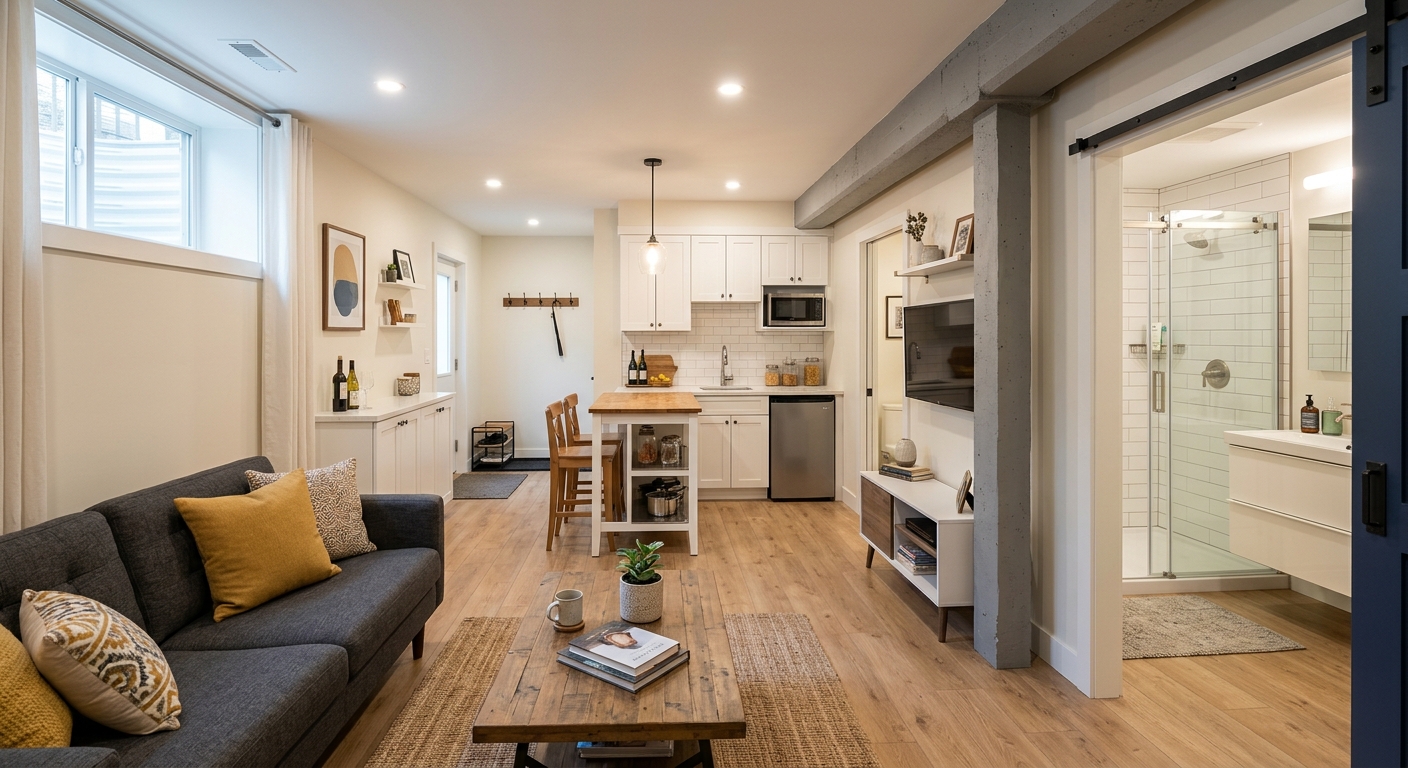
Basement finishing options and costs in Lynn Canyon
Lynn Canyon is where many homeowners want the extra living space, especially when the main floor already feels tight. In 2021, the area’s population was 2,155 (Statistics Canada, 2021 Census), and most neighbourhoods around Lynn Canyon follow the typical Lower Mainland–Southwest pattern: detached homes with basements are common, and a large share of those basements start out unfinished or only partly finished. That means there’s steady demand for contractors who can manage moisture control, code-required separations, and the practical realities of below-grade work.
In the Lower Mainland–Southwest, basement finishing costs are shaped less by deep frost than by persistent wetness and humidity. Coastal BC’s milder temperatures still come with higher rainfall and damp foundations, so builders often prioritize waterproofing details, interior drainage where needed, and mould prevention. At the same time, the market pressure for secondary suites—seen across the Lower Mainland—can push labour, design/engineering, and permitting costs toward the upper end of Canadian ranges.
Contractor availability and pricing can also vary by the specific pocket of Lynn Canyon where you’re working. Near the busier commercial corridors and higher-density pockets (where suite demand is more common), you’ll typically see faster scheduling but higher quote ranges due to higher overhead and more experienced trades booked early.
Below is a practical comparison of common basement finishing scopes and budget ranges in Lynn Canyon, so you can line up apples-to-apples when reviewing estimates.
| Scope |
What's Included |
Permit Required |
Price Range |
| Basic rec room finish (drywall, flooring, pot lights) |
Moisture-appropriate insulation, vapour control where required, drywall/ceiling, LVP or tile-ready subfloor prep, electrical for lighting and outlets, basic trim and paint |
Usually not, unless adding plumbing/electrical beyond code scope or creating a sleeping room |
$15,000–$30,000 |
| Home office finish (insulation, drywall, dedicated circuits) |
Thermal/moisture upgrades, drywall and acoustic treatments, dedicated circuit(s), pot lights or flush fixtures (as applicable), floor prep, paint and trim |
Electrical permit may apply if new circuits are added; confirm scope with contractor |
$22,000–$40,000 |
| Full legal secondary suite (bath, kitchen, egress, fire separation) |
Full bedroom areas with egress compliance, kitchen and bathroom rough-in and finishes, fire separation measures, insulation upgrades, ventilation/dehumidification planning, separate electrical plan, permit-ready layout |
Yes (building permit; suite requirements; egress for sleeping rooms; additional electrical/plumbing permits) |
$80,000–$140,000 |
| Egress window installation only |
Concrete cutting/breakout, window unit and weatherproofing details, rough framing, sill pan and flashing/air-seal integration |
Often yes (elevated risk scope); confirm with local authority |
$6,500–$11,500 |
| Partial finish — framing and rough-in only |
New framing (if needed), electrical rough-in and low-voltage (as scoped), plumbing rough-in (if adding a bathroom), vapour/thermal prep ready for drywall |
Typically yes for electrical/plumbing rough-in; confirm scope |
$15,000–$35,000 |
| Luxury media or wet bar finish |
Feature wall details, built-ins, wet bar with sink/framing for service, upgraded lighting plan, specialty finishes, enhanced ventilation planning where needed |
Yes if adding plumbing lines, wet areas, or altering electrical circuits significantly |
$35,000–$80,000 |
Prices are estimates only and vary by project scope, site access and material selection.
What affects the price of basement finishing in Lynn Canyon
In Lynn Canyon, you can see quotes for the “same” basement finish that land 30–50% apart, especially when one contractor includes the full moisture-control and code path while another assumes a simpler dry space. That spread is common across British Columbia because trades pricing, permitting complexity, and required building envelope measures vary by region. The Lower Mainland–Southwest market often prices higher due to high suite demand and upper-end labour rates, while coastal wetness adds additional steps for waterproofing, vapour control, and mould prevention.
Moisture and thermal requirements are the biggest cost drivers. In Ontario and Alberta, cold winters and frost heave push budgets toward thick exterior-grade insulation, robust vapour barriers, and drainage engineered for freeze-thaw. Coastal BC has milder winter temperatures, but it’s significantly wetter—so cost priorities shift toward water management (foundation crack attention, weeping/relief where warranted, and slab moisture considerations), then ventilation and dehumidification strategies to keep humidity controlled after drywall goes up.
Here are a few examples we run into in Lynn Canyon: (1) A basement with damp corners or prior musty odours often needs targeted waterproofing or air-sealing work before framing; otherwise, your finished ceiling and flooring get compromised. (2) If you’re adding a bathroom, rough-in plumbing and wet-area waterproofing typically add noticeable cost and scheduling coordination. (3) If you’re targeting a legal suite rather than a rec room, the scope escalates quickly—think the difference between a partial rec room budget in the $35,000–$80,000 style range for higher-end finishes versus a suite path that usually lands much higher in the $60,000–$140,000 band.
Local housing age matters too: older foundations may have different crack patterns and drainage performance, which can add thousands to get the moisture baseline right—especially in a coastal climate where humidity doesn’t “dry out” as reliably as in drier regions.
| Price Factor |
Why It Matters |
Cost Impact |
| Finishing scope — rec room vs full suite (biggest variable) |
Suites require more rooms, plumbing/kitchen, fire separation, and expanded electrical design |
Often a 2–4x swing; rec rooms may sit around $15,000–$30,000, suites frequently $60,000–$140,000 |
| Egress window required — cutting concrete foundation |
Concrete breakout, structural considerations, and proper drainage/flashing details |
Typically adds $5,000–$12,000 depending on access and window size |
| Bathroom addition — rough-in plumbing and wet-area tile |
Requires venting strategy, waterproofing system, and labour coordination |
Can add several thousand to the base finish; budget accordingly within your chosen scope band |
| Electrical circuits — dedicated panel, pot lights, outlets |
Below-grade wiring often needs a clear plan; suites require more dedicated loads |
Higher if panel upgrades are required; also includes permit/inspection labour overhead |
| Insulation and vapour barrier — depth of thermal requirement in British Columbia |
Coastal BC moisture control often needs correct vapour strategy and airtightness details |
May add material/labour for envelope prep; usually included more thoroughly in higher quotes |
| Flooring — waterproof LVP recommended for below-grade |
Impervious flooring reduces damage from incidental moisture and helps with long-term maintenance |
Mid to high; it’s commonly priced higher than basic laminate, especially with prep |
| Ceiling height — bulkheads around ducts/beams reduce usable height |
Less clear height can force design changes for insulation, ducting, and lighting |
Can reduce room usability and increase labour; may require rework |
| Permit and inspection fees — suite requires multiple inspections |
Secondary suites trigger building permit plus separate electrical/plumbing processes |
Costs add up; typically pushes projects toward the upper end of regional bands |
Permits & regulations in British Columbia
In British Columbia, basement finishing that includes any of the following usually requires a building permit: adding a sleeping room, adding or changing a bathroom, creating or finishing a secondary suite, adding new plumbing rough-in, and introducing new electrical circuits beyond simple replacement-in-kind work. Egress windows are mandatory for any habitable sleeping area below grade, because emergency escape and rescue access must meet code requirements.
Secondary suite regulations vary by municipality, so you must confirm zoning eligibility, required suite layout, and fire separation details with the local authority before construction starts (commonly a 30–45 minute separation is discussed for suite separation depending on the configuration). Electrical permits and inspections are separate from building permits and must be completed by a licensed electrician. Plumbing work requires a licensed plumber and, in most municipalities, a permit tied to inspections.
What typically does not require a permit: finishing a rec room with no sleeping room, no new plumbing, and no major electrical changes (confirm with your contractor). What does require a permit: creating bedrooms/“sleeping rooms,” installing egress windows for those rooms, adding bathrooms, adding kitchens, adding new circuits, or making the space into a legal suite.
To verify your contractor in Lynn Canyon, ask for (1) their current BC licence details via their online registry presence, (2) a certificate of insurance showing liability coverage, and (3) evidence of the right worker coverage documentation (WSIB/WCB as applicable) and that subcontractors are covered. Request clearance letters where they’re used in your context, and keep copies with your project file before you pay deposits.
Basement suite vs rec room — what makes sense in Lynn Canyon?
Homeowners in Lynn Canyon typically choose between two common basement-finishing paths: a legal secondary suite or a rec room/home office. A legal suite is a more involved build: it requires egress window(s) for each sleeping room, a full bathroom, a kitchenette or kitchen (as designed), separate entrances where required, and fire separation measures between suite areas. It also requires a building permit and usually multiple supporting permits for electrical and plumbing. The upside is stronger rental income potential, which can be decisive in the Lower Mainland’s high-demand rental market—where two-bedroom and family-style basement suites often rent quickly compared to many other regions.
A rec room or home office is typically lower cost and faster. You may avoid egress requirements if you’re not creating a sleeping room. Permits can be simpler when you’re only doing drywall, insulation, flooring, and modest electrical upgrades. With a rec room, you’re buying flexibility—gym, movie room, play space—rather than pursuing rental revenue.
Climate and construction reality in Lynn Canyon also matter. In the coastal wet environment, rec rooms still need moisture control, but suite builds add extra ventilation/dehumidification and more envelope work to keep humidity stable across a longer occupied space. That means you’ll want airtightness and drainage details to be included—especially if you’re finishing below existing slab or around older foundation seams.
For pricing, the difference is often straightforward: if a rec room finish lands around the $15,000–$30,000 range, a legal secondary suite commonly pushes toward the $80,000–$140,000 band because of plumbing, kitchen/bath finishes, fire separation, and egress compliance. A typical justification case is when you can reliably rent the suite—often improving payback over several years—versus using the space exclusively for family needs.
Timeline-wise, suite approvals can take longer due to plan review, inspections, and the need to coordinate multiple trades. Many projects progress quickly after permits are in hand, but approval timelines should be treated as a real schedule variable in British Columbia.
| Option |
Typical Cost |
Permit Needed |
ROI Potential |
Best For |
| Rec room (basic finish) |
$15,000–$30,000 |
Often no, unless adding sleeping room features, new circuits, or plumbing |
Low (no direct rental return) |
Families needing flexible space now |
| Home office (dedicated space) |
$22,000–$40,000 |
May require electrical permit(s) if adding circuits |
Low to moderate (value from utility and reduced commute time) |
Work-from-home households |
| Legal secondary suite (full rental unit) |
$80,000–$140,000 |
Yes (building permit; suite requirements; egress for sleeping rooms; plus electrical/plumbing permits) |
Moderate to high (rental income potential in Lower Mainland demand) |
Owners comfortable managing tenants and upkeep |
| In-law / nanny suite (non-rental) |
$45,000–$85,000 |
Often depends on whether it’s considered a suite and whether you add a bedroom/bath |
Low direct ROI, higher lifestyle ROI |
Multi-generational living |
| Media / entertainment room |
$35,000–$80,000 |
Often yes if electrical scope expands significantly; no if simple finishing only |
Low (comfort-driven value) |
Entertainment-focused homeowners |
| Home gym |
$18,000–$45,000 |
Usually no, unless adding plumbing (e.g., shower) or significant electrical work |
Low to moderate (health and use value) |
Active households wanting privacy |
How to choose a basement finishing contractor in Lynn Canyon
Choosing the right contractor in Lynn Canyon starts with checking credentials you can verify. For British Columbia, ask for their licence details (and confirm they’re eligible for the work scope), plus liability insurance and coverage documentation for their workers. Practically, you’ll want three things: (1) a current certificate of insurance naming you or showing it’s valid for your project, (2) proof they carry the required worker coverage (WSIB/WCB as applicable) and that they can provide a clearance letter when requested, and (3) confirmation that any subcontractors—especially electricians and plumbers—are licensed and insured for their portion of the job.
Get 2–3 itemised written quotes. You should see labour and materials broken out, not one lump sum that hides uncertainty. Make sure the scope is crystal clear: is permit pulling included, who attends inspections, and is disposal/haul-away included? Confirm what’s excluded (for example, any suspected waterproofing remediation, mould remediation, or concrete cutting for egress).
Warranty matters. Look for a workmanship warranty length for the build and whether it’s transferable if you sell. Separate that from product/manufacturer warranties for flooring, lighting fixtures, and mechanical components.
Payment schedules should protect you: never pay more than 10–15% upfront. Use a holdback until key milestones are completed, and don’t release it until you’ve walked the site and have a clear list of “final” items resolved. Finally, request a written start date and completion estimate, plus schedule assumptions (permit approval timing, lead times for windows/egress, and availability of insulation and drywall trades).
- Provide licence verification and insurance certificate before signing.
- Confirm subcontractors are licensed for electrical and plumbing.
- Ask for an itemised quote with line-by-line labour/materials.
- Verify whether permit pulling and inspections are included in the price.
- Confirm site protection and dust control plan (important for occupied homes).
- Request a moisture-control plan (vapour strategy, dehumidification/ventilation notes).
- Clarify exclusions: assumed “dry basement” vs. included remediation.
- Ask how they handle foundation cracks or slab moisture if discovered.
- Confirm disposal/haul-away is included in the proposal.
- Check warranty terms for workmanship and whether they’re transferable.
- Review payment schedule: keep upfront low; holdback at completion.
- Get the schedule in writing including start date and realistic inspection timing.
Red flags I see with basement finishing contractors in Lynn Canyon: (1) they avoid putting scope and exclusions in writing, (2) they quote egress or suite work without discussing permit path and inspections, (3) they’re vague about moisture mitigation (they “assume it’s dry”), (4) they ask for large upfront payments beyond 10–15%, and (5) they won’t clearly provide insurance and coverage documentation for their workers and subcontractors.
Frequently asked questions — basement finishing in Lynn Canyon
What flooring is best for a finished basement in Lynn Canyon?
For Lynn Canyon and the Lower Mainland–Southwest, the “best” flooring is the one that tolerates below-grade humidity swings. I typically recommend waterproof LVP (luxury vinyl plank) or tile on a properly prepped subfloor, because it’s more resilient if you get seasonal dampness or minor condensation. Before any flooring goes down, ensure the contractor has handled moisture control: vapour strategy, correct insulation placement, and attention to perimeter sealing. If you’re finishing around older foundation seams, this matters even more. For higher-activity spaces like gyms or wet bar areas, tile can be a good match. If you’re targeting a budget rec room in the $15,000–$30,000 range, LVP is often the best value-to-performance choice.
How do I prevent moisture problems in a finished Lynn Canyon basement?
Moisture control starts before drywall: in British Columbia’s coastal climate, basements can stay humid even if they don’t feel “wet.” The practical steps are (1) verify there’s no active water entry or hidden damp spots, (2) use the right vapour barrier/air-seal strategy for below-grade walls, and (3) plan ventilation and dehumidification so humidity doesn’t get trapped after finishing. If the foundation shows cracks or recurring damp corners, address that with drainage or waterproofing details first—finishing over a problem is where mould risk grows. Also consider slab moisture: you may need approved subfloor approaches. When quotes vary widely, the cheaper one often skips these envelope details, which is why you’ll see higher-cost quotes trend toward the $35,000–$80,000 band for more comprehensive moisture-mitigation work.
What is the ROI on finishing a basement in Lynn Canyon?
ROI depends on whether you’re creating rental income or just increasing household utility. For a legal secondary suite, ROI is often the strongest driver in Lynn Canyon and the broader Lower Mainland–Southwest, where suite demand is high and rental markets tend to reward additional units. In contrast, a rec room or home office usually improves day-to-day living value and can help resale appeal, but it doesn’t generate monthly revenue. As a ballpark, homeowners can expect suite payback timelines that depend on permitting success, rental rates, and financing—often several years when the project is done properly. If you’re comparing budgets, a rec room finish in the $15,000–$30,000 range may be a simpler ROI on lifestyle value, while suites that can land around the $80,000–$140,000 band aim for rental income to justify the added cost.
How do I compare basement finishing quotes in Lynn Canyon?
Start by comparing apples-to-apples scope. Ask each contractor for an itemised quote that separates labour and materials and specifies what’s included for insulation, vapour control, drywall/ceiling, electrical lighting/outlets, flooring prep, and cleanup/disposal. Confirm whether they’re pulling permits and handling inspections for your specific scope—especially if you’re adding a bathroom, sleeping room, or egress window. Make sure exclusions are clear, such as whether waterproofing remediation is included if dampness is discovered. A good contractor will also outline assumptions and the moisture-control approach relevant to coastal BC. Finally, ask for the payment schedule and warranty terms. If one quote is much lower, it may be skipping moisture mitigation or egress/suite requirements, which can turn into expensive rework later.
Should I waterproof before finishing my basement in Lynn Canyon?
In many Lynn Canyon basements, yes—at least you should evaluate waterproofing needs before you finish. Coastal BC’s wet climate means humidity and water pressure can show up in ways that aren’t obvious until the space is enclosed. If you have signs like musty odours, persistent damp spots, efflorescence, or recurring leaks along cracks/joints, addressing waterproofing and drainage details before framing and drywall is the right approach. Even if you don’t see active leaks, perimeter sealing and a correct vapour strategy are still essential to reduce long-term mould risk. If you’re installing an egress window or adding wet areas, it’s even more important to confirm drainage and weatherproofing details during construction. Some projects start in the rec-room range ($15,000–$30,000), but moisture remediation can push you toward the higher end if remediation is required.
What ceiling height do I need to finish a basement in British Columbia?
British Columbia projects don’t work with a single “magic” number because usable ceiling height depends on the existing structure, beams/ducting, and where electrical and HVAC must pass. In practice, the key is meeting code requirements for habitable space while planning for insulation depth, ventilation/dehumidification components, and any bulkheads. If you’re adding a bathroom fan duct, or you have ductwork or drop beams, you’ll likely need soffits that reduce height. A professional will verify the lowest point and then propose a ceiling strategy that maintains as much clear height as possible. If you’re creating bedrooms (sleeping rooms) and adding egress, the ceiling/ventilation plan becomes even more important. Plan for realistic reductions when budgeting—especially in older Lower Mainland homes where service runs can be in the ceiling cavity.