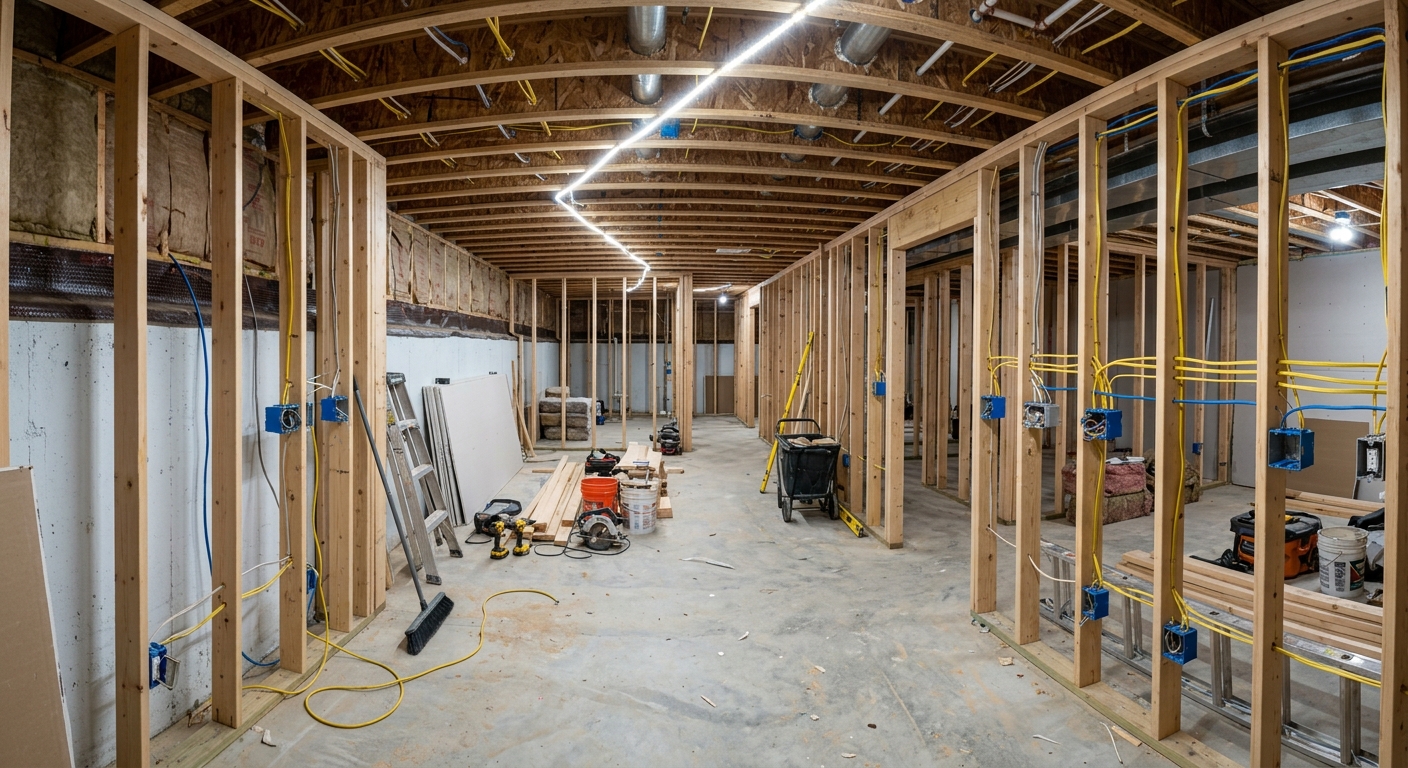
Basement finishing options and costs in Metrotown
Basement finishing in Metrotown is popular because most homes in this part of Burnaby and the broader Lower Mainland—Southwest area have deep basements that can be upgraded into a practical rec room, home office, or a full secondary suite. With a 2021 population of 52,355 in the city (Statistics Canada, 2021 Census), demand for extra living space and rental income stays steady—especially around the Metrotown and Brentwood corridor, where families and renters compete for available units. That market pressure affects contractor availability and pricing: the same “finish” can price very differently depending on whether you’re building a simple dry space or adding suite-level plumbing, electrical, and life-safety features.
Lower Mainland–Southwest moisture and code requirements are the main drivers of cost. Even though coastal BC winters are milder than Ontario and Alberta, the region is wetter and rainfall can push more water through foundations. That shifts the budget toward waterproofing checks, interior drainage details, proper vapour/air control, and mould prevention before drywall goes up. In older neighbourhoods around Metrotown, you’ll often see finished basements that were done quickly in the past—then moisture issues show up later—so many homeowners now pay for better preparation and ventilation up front. If you’re aiming for a legal rental, the cost is higher not just for finishes, but for egress, fire separation planning, and multiple inspections.
Below is a practical comparison of common options in Metrotown, using current Lower Mainland price bands to help you benchmark your quotes before you sign.
| Scope |
What's Included |
Permit Required |
Price Range |
| Basic rec room finish |
Insulation assessment, insulation upgrade as needed, drywall, ceiling finish, flooring, paint, pot lights, basic trim |
Usually no (if no plumbing/electrical changes) |
$15,000–$35,000 |
| Home office finish |
Insulation upgrades, drywall, dedicated circuits/outlets, paint, flooring, ventilation/dehumidification improvements if required |
Often no for minor work; permit may apply if electrical scope expands |
$20,000–$45,000 |
| Full legal secondary suite (bath, kitchen) |
Fire separation planning, kitchenette, full bathroom rough-in and finish, egress window(s) for sleeping areas, mechanical ventilation, electrical upgrades, suite finishes |
Yes |
$60,000–$140,000 |
| Egress window installation only |
Concrete cutting, window purchase/installation, waterproofing detailing, framing around opening, exterior grading touch-ups |
Yes (life-safety work) |
$5,000–$12,000 |
| Partial finish — framing and rough-in only |
Stud framing, insulation, vapour strategy, subflooring prep as needed, rough-in for electrical and/or plumbing as specified |
Usually yes if plumbing/electrical rough-in is included |
$25,000–$55,000 |
| Luxury media or wet bar finish |
Acoustic treatment, built-ins, higher-end flooring, upgraded electrical (more outlets/pot lights), wet bar (where allowed), feature lighting |
Often yes for electrical changes; typically yes if wet bar plumbing is added |
$45,000–$90,000 |
Prices are estimates only and vary by project scope, site access and material selection.
What affects the price of basement finishing in Metrotown
In Metrotown, quotes for the same “basement finish” can swing by 30–50% across the Lower Mainland–Southwest simply because the real scope isn’t just drywall and flooring. Two contractors may both describe “a finished rec room,” but one includes moisture remediation, upgraded vapour/air control, and engineered detailing—while the other assumes the existing foundation and slab are already stable. That difference is what changes your budget most, and it’s why Lower Mainland–Southwest pricing often stays closer to the mid-five-figure range even for non-suite projects.
Moisture and thermal requirements vary significantly by region. In colder provinces like Ontario and Alberta, basements must handle deep winter frost and frost-heave risk, so budgets often lean into thicker insulation, robust vapour barriers, and drainage and foundation details before framing. Coastal BC has milder temperatures but higher moisture exposure, so cost priority shifts toward waterproofing verification, foundation crack management, proper ventilation, and dehumidification to prevent mould. In practice, that means you can spend more on moisture control in Metrotown even when the temperature extremes look less severe.
Market demand also matters. Secondary suite demand in Metro Vancouver keeps labour rates, design/engineering costs, and permitting/inspection fees elevated—similar pressure to other high-rental markets. That’s why a full legal secondary suite typically lands in the $60,000–$140,000 band, while a partial rec-room style finish may stay closer to $15,000–$35,000 when the mechanical scope is minimal.
Concrete examples from Metrotown projects: (1) If your foundation has weeping cracks or you’ve had past musty odours, contractors often add interior drainage inspection, membrane upgrades, and a better air-sealing plan—adding cost but reducing callbacks. (2) If you want a bathroom in a below-grade wet area, rough-in plumbing, venting, and tile waterproofing details can push you toward the upper end of the $35,000–$80,000 full basement finishing band. (3) Ceiling height constraints from ducts or beams can require bulkheads and reduce usable area, which changes both labour and finishing materials.
| Price Factor |
Why It Matters |
Cost Impact |
| Finishing scope — rec room vs. full suite |
Suite work adds kitchens, bathrooms, separation planning, more electrical, and often more ventilation and inspections |
$15,000–$80,000+ spread depending on what you add |
| Egress window required — cutting concrete foundation |
Concrete cutting, waterproof detailing, and structural/air-seal work around the opening |
$5,000–$12,000 per window |
| Bathroom addition |
Rough-in plumbing, drain/vent runs, moisture-rated materials, waterproofing membranes |
$10,000–$30,000 typical lift |
| Electrical circuits |
Dedicated circuits, upgraded panel work (if needed), GFCI/AFCI devices, pot lights, extra outlets |
$2,500–$12,000 depending on panel capacity |
| Insulation and vapour barrier |
In Metro Vancouver’s wet climate, vapour/air control and moisture strategy are essential to avoid mould behind walls |
$3,000–$15,000 depending on wall assembly and remediation |
| Flooring — waterproof LVP recommended for below-grade |
Below-grade floors need forgiving, moisture-resistant installs with correct underlay choices |
$1,500–$7,000 uplift vs basic materials |
| Ceiling height |
Bulkheads for ducts/beams and maintaining clearances can reduce usable area and add finish labour |
$1,000–$8,000 depending on framing needs |
| Permit and inspection fees |
Secondary suites require multiple inspections; higher complexity increases administrative and coordination time |
$1,500–$6,500 or more by scope |
Permits & regulations in British Columbia
In British Columbia, basement finishing that adds a sleeping room, a bathroom, new electrical circuits, plumbing rough-in, or a secondary suite typically requires a building permit. Egress windows are mandatory for any habitable sleeping area below grade, because it’s a life-safety requirement. Secondary suite regulations vary by municipality—so in Metrotown and the broader Lower Mainland–Southwest, you should confirm zoning, allowable suite configuration, and fire separation expectations with the local authority before work starts. It’s also common that electrical permits and inspections are handled separately from the building permit, and the electrical work must be done by a licensed electrician. Plumbing work likewise generally requires a licensed plumber and permits in most municipalities.
To be concrete: permits are usually required for (1) adding or relocating a bathroom, (2) installing or modifying plumbing and venting for a wet area, (3) adding a kitchenette, (4) creating a legal secondary suite, (5) adding new circuits or significantly extending wiring/panels, and (6) any new sleeping area below grade that needs egress. Permits are often not required for simple “finish-only” work where there are no changes to plumbing, electrical, or life-safety features—like painting, drywall replacement, or flooring—though it still depends on what’s being changed.
Homeowners can verify a contractor in three steps: check the contractor licensing status through the BC online registry, review their certificate of insurance (including liability coverage) and ask for a current clearance letter if applicable, and confirm they have the appropriate coverage for workers (commonly WCB/WCB-equivalent coverage in BC). Request these documents before signing the contract and make sure the scope matches what the permit will cover.
Basement suite vs rec room — what makes sense in Metrotown?
In Metrotown, the two most common basement finishing paths are (1) a legal secondary suite and (2) a rec room or home office. A legal secondary suite typically includes egress windows for each sleeping room, a full bathroom and kitchenette (or kitchen area), proper fire separation considerations between suite and primary areas, and it needs a building permit. In practice, it can also involve separate entrance considerations and enhanced mechanical and electrical planning. The upside is that you’re adding a rental-capable space in a high-demand market where extra units can have strong rental income potential. The drawback is cost and complexity: many projects land in the $60,000–$120,000+ range, and the timeline can extend due to permitting and inspection scheduling.
A rec room or home office is usually faster and lower cost because it often avoids egress requirements unless you’re adding a bedroom. If you keep it as an office (no sleeping area), you can often stay closer to the $15,000–$35,000 partial finish or rec-room style band, assuming minimal plumbing and limited electrical changes. That can be a better choice if you want a usable space now—especially in a wet, coastal BC climate where the biggest risk is moisture behind walls, not winter frost.
Consider a dollar example: if your basement can be finished as a rec room at around $25,000–$35,000, the jump to a legal secondary suite at $80,000+ is only justified if you plan to rent promptly and can handle the permitting/inspection steps. In Metrotown’s rental market, many homeowners look at the revenue potential to decide, but zoning rules still apply—so don’t assume any city will permit a secondary suite everywhere.
In British Columbia, typical secondary suite approval steps involve drawings/specs, permit submission, plan review, then inspections during and at completion. While timelines vary, planning ahead for permit lead times and contractor scheduling is key, particularly when egress window cut-outs and waterproofing detailing are part of the plan.
| Option |
Typical Cost |
Permit Needed |
ROI Potential |
Best For |
| Rec room (basic finish) |
$15,000–$35,000 |
Usually no (finish-only, no plumbing/electrical changes) |
Low (no rental unit) |
More living space quickly |
| Home office (dedicated space) |
$20,000–$45,000 |
Often no; may apply if electrical changes expand |
Low to moderate (quality-of-life, potential value lift) |
Work-from-home setup |
| Legal secondary suite (full rental unit) |
$60,000–$140,000 |
Yes |
High (rental income) |
Maximizing rental return |
| In-law / nanny suite (non-rental) |
$45,000–$95,000 |
Often yes (if it changes bedrooms/wet areas) |
Low to moderate (family use) |
Family living, flexibility |
| Media / entertainment room |
$35,000–$90,000 |
Usually no for finish-only; yes if wet bar/plumbing or major electrical |
Low to moderate (value through features) |
High-comfort living space |
| Home gym |
$20,000–$55,000 |
Usually no (finish-only) |
Low (no rental unit) |
Low-impact, durable finishes |
How to choose a basement finishing contractor in Metrotown
Start by verifying British Columbia licensing and coverage, then match that to the scope you want. Ask for proof that the contractor is eligible/licensed for the trade work they’ll do, plus a current certificate of liability insurance. For workers, confirm they have proper coverage through the province’s workplace insurance system (WCB/WCB-equivalent clearance where applicable). In practice, you can check online registry status and then request documents in writing: (1) licence details, (2) certificate of insurance, and (3) the clearance letter or equivalent confirmation. If they can’t provide these promptly, that’s a major warning sign.
Next, get 2–3 itemised written quotes—ideally with a labour and materials breakdown rather than one lump number. Read exclusions line-by-line: is permit pulling included or is it your responsibility? Is debris removal and disposal included? Are waterproofing/moisture-mitigation tasks included if moisture is discovered during demo? A basement finishing contract should also specify product names where possible (insulation type, vapour/air barrier approach, flooring underlay, paint systems) so “allowances” don’t balloon later.
For warranty, confirm workmanship warranty length and what it covers (for example, cracks, settlement gaps, or finish failure). Also ask about manufacturer warranties for flooring, insulation systems, and ventilation/dehumidification components—and whether warranties are transferable to the homeowner. Payment schedule matters: never pay more than 10–15% upfront; use progress payments and keep a holdback until completion and final walkthrough. Finally, get the start date and a completion estimate in writing, because scheduling delays often affect inspection windows in British Columbia.
- Ask for licence and proof of insurance before signing; keep copies for your records.
- Confirm WCB/workplace coverage status (and ask for the clearance letter or equivalent).
- Require itemised quotes: labour, materials, allowances, and line-by-line totals.
- Ensure permits and inspections responsibilities are clearly stated (who pulls the permit, who pays).
- Ask how they handle moisture discoveries (what changes if moisture is found).
- Verify egress requirements early if you’re adding bedrooms.
- Check whether demolition, disposal, and dust control are included.
- Confirm the ventilation/dehumidification plan for below-grade rooms.
- Request a detailed scope for electrical and plumbing: outlets, pot lights, circuits, rough-in, and fixtures.
- Review flooring specification: below-grade underlay and LVP suitability for moisture.
- Get warranty terms in writing, including workmanship and product warranty start dates.
- Use a payment schedule with a holdback until final completion and punch-list sign-off.
Red flags in Metrotown include contractors who won’t provide licence/insurance documents, quotes that don’t address moisture control (vapour/air sealing and ventilation) for below-grade walls, “allowance-only” estimates for major items like flooring or bathroom waterproofing, and contracts that avoid stating who pulls permits and handles inspection scheduling. Another big one: crews that start framing without a clear plan to protect the slab/walls from moisture during construction.
Frequently asked questions — basement finishing in Metrotown
What insulation do I need for a basement in Metrotown's climate?
In Metrotown and the wider Lower Mainland–Southwest, insulation needs aren’t only about warmth; they’re about controlling moisture movement. Most basement assemblies are insulated with an approach that reduces condensation risk and supports an airtight layer, then you add a vapour/air strategy that matches the wall build-up. Contractors typically recommend insulation that fits the stud depth (and can accommodate required services), and they’ll confirm whether your walls and slab show signs of moisture before selecting products. If you’re finishing to rec-room level, you may still need upgraded insulation to keep comfort consistent. If you’re building toward a higher-end finish or adding wet areas/suite components, the insulation and air-sealing plan tends to become more detailed, which is one reason suite projects usually sit in the $60,000–$140,000 range.
Do I need a vapour barrier in my Metrotown basement?
Usually, yes—vapour and air control are key to preventing moisture from reaching cold surfaces where condensation can happen behind drywall. In coastal BC’s wetter conditions, the goal is to manage vapour movement correctly for your specific wall assembly and existing foundation condition, not just “add plastic behind drywall.” A good contractor will assess moisture indicators first (musty odours, staining, efflorescence, past leaks) and then design the vapour/air strategy accordingly. If you skip this step and only focus on finishing, you risk mould growth hidden in cavities. This is one reason homeowners sometimes move from a basic finish toward a higher budget: better moisture control is a foundation for the rest of the work, even when your target scope is “only” a rec room.
What flooring is best for a finished basement in Metrotown?
For basements in British Columbia, a moisture-tolerant flooring choice is usually best. Many homeowners opt for waterproof or water-resistant LVP because it can handle minor humidity fluctuations better than traditional materials, provided the subfloor is prepared properly. The underlay matters too—avoid soft underlay that traps moisture. If your basement has any history of dampness, insist the contractor includes the correct prep steps (leveling, addressing moisture sources, and using appropriate barrier products where needed). For comfort, some builds also add thermal underlayment layers, but those are selected carefully so they don’t create a moisture trap. Flooring can look like a “small” cost item, yet it’s part of why a typical rec-room finish can fall around $15,000–$35,000—while more involved upgrades and better systems can push higher.
How do I prevent moisture problems in a finished Metrotown basement?
Prevention starts before drywall goes up. In Metrotown, focus on three layers: (1) identifying and addressing the water source (foundation seepage, crack leakage, grading issues), (2) using correct vapour/air sealing so moisture doesn’t migrate into the wall cavities, and (3) controlling indoor humidity with proper ventilation and, where warranted, dehumidification. A quality contractor will also plan for construction sequencing—protecting finishes and insulation during wet trades work and ensuring the mechanical system is operating safely. If the slab or walls show efflorescence or dampness, you may need waterproofing checks or drainage detailing first; that’s one of the biggest cost shifters between “finish only” and higher budgets. In Lower Mainland–Southwest projects, moisture control is often what differentiates a smooth renovation from an expensive rework.
What is the ROI on finishing a basement in Metrotown?
ROI in Metrotown depends heavily on whether you’re creating additional rentable space versus adding personal usable square footage. A legal secondary suite can have stronger income potential, which is why those projects commonly fall in the $60,000–$140,000 range; the intent is to recover the renovation through rent. However, ROI still hinges on permitting success, configuration, and whether the unit complies with egress and fire separation expectations under BC requirements and local rules. If you’re doing a rec room or home office, the ROI is more about value-of-life and potential secondary value lift, and the project may sit in the $15,000–$35,000 band when plumbing and major electrical changes are minimal. The most accurate way to estimate ROI is to compare your all-in cost to realistic rent estimates and the time to permit and finish.
How do I compare basement finishing quotes in Metrotown?
To compare quotes fairly in Metrotown, don’t just compare totals—compare scope, moisture strategy, and what’s excluded. Ask for itemised quotes with a labour/materials breakdown, and confirm whether permit pulling and inspections are included (especially if you’re adding a bathroom, sleeping area, or secondary suite). Verify whether egress work is included where needed, and whether disposal/demolition and dust control are covered. Look for clear specifications: insulation type, vapour/air approach, waterproofing measures for wet areas, and flooring/underlay selections for below-grade conditions. Then compare warranty terms: workmanship warranty length and product warranty details. Finally, check payment schedules—reputable contractors typically avoid collecting large upfront payments and hold back until completion. A quote that sounds cheap but skips moisture mitigation is often the one that costs more later.