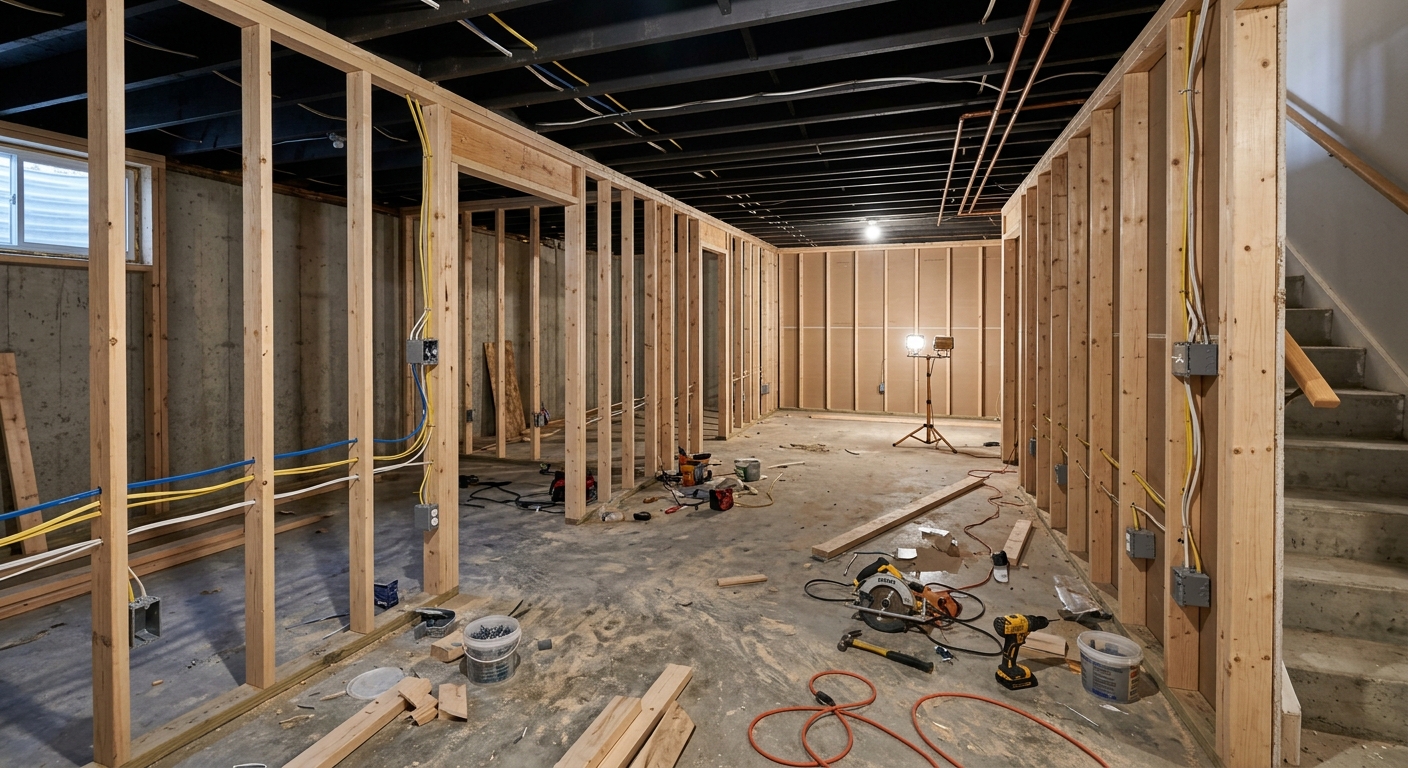
Basement finishing options and costs in Chinatown
Basement finishing in Chinatown, Alberta typically starts with one key question: do you want a simple rec space, a dedicated home office, or a fully legal secondary suite? Chinatown’s local housing stock is shaped by older, mature neighbourhood patterns, and the majority of homes in the Calgary area have full basements—often unfinished or only partially finished—so demand for insulation, moisture control, and reliable interior finishes is steady. In the broader Calgary economic region, the area’s population is still relatively concentrated at about 2,250 people in Chinatown (Statistics Canada, 2021 Census), which keeps contractor response times reasonable compared with larger boom markets.
In Calgary’s cold winter climate, costs are strongly driven by thermal performance and freeze-thaw resilience. Contractors don’t just hang drywall; they plan vapour control, insulation thickness, and foundation condition assessment before framing, because moisture management is what protects your finished surfaces. Compared with coastal BC—where mild-but-wet conditions push waterproofing and mould prevention to the front—Calgary projects lean more heavily toward insulation depth, air sealing, and detailing that reduces frost heave risk.
Where the trade is especially in demand, many homeowners in the Beltline-adjacent corridor and along the inner-city shopping strip area of Chinatown are converting older basements into offices and rentals as families look for more usable space without moving. From that starting point, your best “apples-to-apples” comparison is the table below.
| Scope |
What's Included |
Permit Required |
Price Range |
| Basic rec room finish (drywall, flooring, pot lights) |
Insulation & vapour barrier where needed, drywall, taped/finished ceilings and walls, LVP or carpet, basic lighting (e.g., 4–8 pot lights), standard outlets, paint |
Usually no permit if no new plumbing/electrical beyond minor code-compliant updates; confirm scope with contractor |
$15,000 – $35,000 |
| Home office finish (insulation, drywall, dedicated circuits) |
Framing infill or drywall upgrades, insulation & vapour control, drywall/paint, acoustical consideration if requested, dedicated electrical circuits/outlets, data-ready locations |
Often permit required if adding new circuits/panel work; otherwise may be treated as interior finish |
$20,000 – $50,000 |
| Full legal secondary suite (bath, kitchen, egress, fire separation) |
Kitchen cabinetry & counter, full 3-piece bath, egress window(s), fire separation between suites, insulation upgrades, electrical & plumbing rough-in/finish, appropriate ventilation, smoke/CO compliance |
Yes—building permit required for secondary suite work, bedrooms, plumbing/electrical additions, and egress |
$65,000 – $140,000 |
| Egress window installation only |
Cut-through foundation (as required), egress well/ladder details where applicable, new window unit, proper grading/water management detailing, disposal |
Yes if it creates/adjusts a habitable sleeping area under grade; verify with city authority |
$2,500 – $15,000 |
| Partial finish — framing and rough-in only |
Selective framing (e.g., future wall lines), rough electrical and/or plumbing runs where needed, insulation set-up, air/vapour control prep, no final flooring/paint |
Permit often required if rough-in includes new plumbing/electrical or you’re preparing a future suite |
$12,000 – $30,000 |
| Luxury media or wet bar finish |
Feature walls, engineered beams/bulkheads as needed, premium flooring, upgraded lighting design, wet bar with plumbing provisions, custom millwork and trim |
Yes if adding plumbing lines, increasing circuits, or building out a new wet area |
$55,000 – $90,000 |
Prices are estimates only and vary by project scope, site access and material selection.
What affects the price of basement finishing in Chinatown
Even when two homeowners in Chinatown, Alberta describe the “same” basement, Calgary-area quotes can swing by 30–50% once you factor moisture control, insulation depth, and whether the project triggers more regulated work like a bathroom or secondary suite. The reason is that “finished basement” is not one standard build—labour and materials change dramatically based on foundation condition, electrical scope, and code requirements for habitable spaces and bedrooms.
Moisture and thermal requirements vary significantly by region and strongly affect cost. In Ontario and Alberta, colder winters increase the importance of robust exterior-grade insulation details, continuous vapour control, and drainage/grade checks before walls are framed. Coastal BC is milder but wetter, so many assemblies prioritize waterproofing and mould prevention first; you may still need insulation, but the cost mix shifts. In Calgary, the practical takeaway is that your budget can’t be cut at the vapour barrier stage without risking long-term issues—particularly in older basement walls where interior finish hides early moisture pathways.
Basement suite demand also changes labour and permitting costs. Rental income potential tends to be highest in expensive urban markets like Toronto and Vancouver, where permits and secondary-suite labour costs often run higher; Alberta’s smaller market typically keeps absolute costs lower, but the scope requirements are still real. In a Chinatown-style upgrade, you’ll often see the biggest differences between a $35,000–$90,000 full basement finishing project and a $65,000–$140,000 suite approach.
Concrete local examples: (1) if your foundation has signs of seepage or poor downspout discharge, contractors may need extra drainage and surface prep before insulation, adding days and materials; (2) a required egress window can add major concrete cutting and well detailing—on its own it commonly lands in the $2,500–$15,000 band; (3) if you’re adding a bathroom, the rough-in plumbing and wet-area tile build-up typically costs more than homeowners expect, especially when relocating vents and traps in an older mechanical layout.
| Price Factor |
Why It Matters |
Cost Impact |
| Finishing scope — rec room vs. full suite |
Suites need kitchens, bathrooms, fire separation, ventilation, and multiple code-compliant rooms |
$35,000 – $90,000 for full finishes vs $65,000 – $140,000 for suites |
| Egress window required — cutting concrete foundation |
Concrete cutting, new window well, and grading/water management are labour-intensive |
$2,500 – $15,000 depending on foundation type and access |
| Bathroom addition — rough-in plumbing and wet area tile |
Moving drains/vents, waterproofing systems, and tile build-up increase labour and material costs |
Often adds several thousand dollars to a finish scope |
| Electrical circuits — dedicated panel, pot lights, outlets |
Basement codes typically require dedicated circuits for certain loads; more rooms means more wiring |
Can shift the quote by 10%–25% when electrical is expanded |
| Insulation and vapour barrier — depth of thermal requirement in Alberta |
Cold exposure and frost heave risk demand correct assembly and tight vapour control |
Often adds cost but prevents expensive rework; common driver in Calgary builds |
| Flooring — waterproof LVP recommended for below-grade |
Below-grade floors must tolerate minor humidity swings; LVP with proper underlayment is common |
Shifts materials line item; can be modest to moderate depending on finish level |
| Ceiling height — bulkheads around ducts/beams |
Bulkheads reduce usable space and can add framing, drywall, and lighting complexity |
May add labour and impact layout efficiency |
| Permit and inspection fees — secondary suite requires multiple inspections |
More regulated components mean more inspection touchpoints and scheduling coordination |
Typically increases overhead and can slow timelines |
Permits & regulations in Alberta
In Alberta, any basement finishing that adds a sleeping room, bathroom, new electrical circuits, plumbing rough-in, or a secondary suite generally requires a building permit. Egress windows are mandatory for any habitable sleeping area below grade, and the scope that triggers code compliance is broader than many homeowners expect. Secondary suite regulations vary by municipality; before you start, confirm zoning and the required fire separation between suites (commonly a 30–45 minute rating, depending on the assembly and local interpretation) with the local authority. Electrical permits are separate from the building permit and must be handled by a licensed electrician. Plumbing work also typically requires a licensed plumber and permits in most municipalities.
Concrete examples of work that DOES require a permit: adding a bedroom with egress, roughing in a bathroom sink/shower/toilet, adding a kitchenette, installing a second kitchen range/hood and related electrical circuits, or converting the basement into a legal suite with a separate living area. Work that typically does NOT require a permit is finishing-only drywall, painting, and flooring replacement when no new plumbing/electrical is being added—though if you’re altering wall layouts or adding wiring, that can push the project into permit territory.
For a Chinatown homeowner, verify a contractor’s Alberta licence by checking the relevant online registry for trades where applicable, then request a current certificate of insurance (liability) and a clearance letter if your contractor participates in the appropriate coverage clearance process. Also confirm WSIB/WCB coverage directly with documentation before work begins—don’t rely on verbal assurances. A permit number and inspection plan should show up in the written contract for any project that needs it.
Basement suite vs rec room — what makes sense in Chinatown?
In Chinatown, the two most common basement-finishing paths are a legal secondary suite and a rec room (or home office). A legal secondary suite is the higher-cost route and comes with higher compliance expectations: you typically need an egress window in each sleeping room, a full bathroom, a kitchenette, separation between suites (including fire separation), and a building permit for the suite work. You’ll also want a separate entrance plan where required, and you must confirm zoning—some municipalities do not allow secondary suites in every scenario.
A rec room or home office generally costs less and is faster to complete because you can avoid egress requirements unless you’re adding an actual bedroom. If the space is being used as a family room, gaming space, or office, the project often fits into the “full basement finishing” concept, commonly in the $35,000 – $90,000 band. The trade-off is that you won’t capture rental income, but you may still gain value through livability and reduced crowding.
In Calgary’s colder climate, the suite vs. rec decision still hinges on moisture/thermal assembly. If you’re already upgrading insulation, vapour control, and ventilation for comfort, building out a suite can be justified—especially if you can cover the additional expense with rental income and your project timeline aligns. In an inner-city rental-focused environment, homeowners often use a direct comparison: if a rec room lands around $25,000 – $50,000 and the suite pushes into $65,000 – $140,000, the extra $30,000–$80,000 needs to be weighed against how quickly you can rent, how stable the demand is, and whether the permitting/inspection schedule fits your plans.
For Chinatown specifically, it’s smart to verify your target monthly rent assumptions with local listings and to ask the contractor for a realistic permit lead time. Suite approvals can affect start dates, and older foundation layouts sometimes require additional detailing around egress and plumbing routes.
| Option |
Typical Cost |
Permit Needed |
ROI Potential |
Best For |
| Rec room (basic finish) |
$15,000 – $35,000 |
Usually no if no new plumbing/electrical beyond minor work |
Low (value is livability, not rent) |
Families needing usable space quickly |
| Home office (dedicated space) |
$20,000 – $50,000 |
Often if adding new circuits or significant electrical work |
Low to medium (value via productivity; not rental) |
Work-from-home set-ups and controlled noise needs |
| Legal secondary suite (full rental unit) |
$65,000 – $140,000 |
Yes—building permit, egress, plumbing/electrical, suite separation |
Medium to high (rent can repay over time) |
Owners targeting rental income and longer time horizon |
| In-law / nanny suite (non-rental) |
$55,000 – $110,000 |
Depends on bedroom/bath/electrical/plumbing scope; verify intent with authority |
Low to medium (personal value; sometimes future flexibility) |
Multi-generational living without managing a tenant |
| Media / entertainment room |
$35,000 – $90,000 |
Often if adding wet bar/plumbing or expanded electrical |
Low to medium (amenity value) |
Home theatre lovers and premium finish budgets |
| Home gym |
$20,000 – $55,000 |
Usually no if no major new plumbing/electrical |
Low (value is comfort and use) |
Active households who want sound control and durability |
How to choose a basement finishing contractor in Chinatown
Choosing the right contractor matters in Alberta because basement work is where insulation, vapour control, electrical, and moisture detailing meet real-world conditions. Start with verifying Alberta trade credentials: ask for proof of licensing for electrical and plumbing work (or confirm your contractor subcontracts only licensed trades). For coverage, request liability insurance documents and verify WSIB/WCB clearance or proof of appropriate coverage—don’t accept a screenshot without confirming validity. If anything is unclear, a reputable contractor will help you understand how permits are handled and which trade is responsible for each scope.
Next, get 2–3 itemised written quotes, not lump sums. You want labour and materials broken out by line items like insulation assembly, drywall/tape, electrical labour, pot lights quantities, flooring prep, bathroom rough-in, and disposal. Read the scope carefully for exclusions: is permit pulling included or separate? Is old insulation/disposal included? Are patching and refinishing of ceilings and door framing included if they have to open walls? Clarify who coordinates inspections and how schedule changes are priced.
For warranty, look for a clear workmanship warranty length and product manufacturer warranties for major items (spray foam/insulation systems, flooring, ventilation equipment). Ask whether the warranty is transferable to the next homeowner. Payment schedule should be conservative: never pay more than 10–15% upfront, and keep a holdback until substantial completion and final cleanup. Insist on a start date and an estimated completion date in writing.
- Written quotes with scope-by-scope inclusions (insulation, vapour barrier, drywall, electrical, plumbing).
- Confirm whether permits are pulled by the contractor or by you, and list the permit numbers/inspection steps.
- Moisture plan in the contract: foundation assessment, grading/drainage notes, vapour barrier method.
- Electrical scope detailed: outlets count, pot light layout, and circuit plan.
- Bathroom/wet area details: waterproofing system, membrane type, ventilation strategy, and tile underlayment.
- Flooring specification: LVP/underlayment system appropriate for below-grade humidity.
- Egress window plan (if needed): who does cutting, well details, disposal, and final grading.
- Waste disposal included or budgeted separately—no “surprise” hauling charges.
- Clear allowance pricing for upgrades (fixtures, tile level, cabinets, lighting trims).
- Warranty terms in writing: workmanship duration plus manufacturer warranty documents.
- Concrete timeline with milestones: framing date, inspection date, rough-in complete, drywall finish, trim.
- Payment schedule with milestones; holdback held until punch list is complete and final inspection passes.
Red flags to watch in Chinatown basement bids: (1) “One price fits all” quotes with no moisture/thermal assembly detail; (2) vague electrical/plumbing language (no circuit counts, no clarification of who pulls permits); (3) asking for large upfront deposits beyond 10–15%; (4) no written warranty terms or unclear subcontractor responsibility; (5) refusing to put schedule and inspection coordination in writing.
Frequently asked questions — basement finishing in Chinatown
Can I finish my basement myself in Alberta?
In Alberta, homeowners can do some parts of a basement finish themselves, but you need to be careful about what triggers permits and licensed trades. If you’re changing the use of the space—adding a bedroom, adding a bathroom, installing or relocating plumbing, adding new electrical circuits, or creating a secondary suite—permits are typically required and the plumbing/electrical work must be done by licensed professionals. In practical Chinatown terms, DIY is often best for finish-only steps like painting and some trim work, while leaving insulation/vapour control detailing, electrical panel/circuit work, and wet-area waterproofing to qualified trades. A typical basic rec room finish commonly falls around $15,000 – $35,000, so DIY mistakes that cause moisture problems can erase the savings. If you want to DIY, bring a contractor in for the “critical” layers and inspections.
How much does basement framing cost in Chinatown?
Basement framing cost varies mainly with wall count, ceiling complexity (bulkheads around ducts/beams), and whether you’re building out a suite layout or just partitioning a rec area. In Calgary-area basements, framing is rarely a standalone line item because it usually comes with insulation and vapour control that are critical in cold winters. For budgeting, homeowners often start by scoping whether they’re aiming for a rec room finish or a more complete suite build. Basic finishing projects commonly land in the $15,000 – $35,000 band, while full basement finishing is commonly $35,000 – $90,000; framing is a component inside those totals. If you add egress and/or a bathroom later, framing complexity and rough-in planning increase, so contractors may quote more once the layout is confirmed.
What permits are required for a basement suite in Chinatown?
For a basement suite in Alberta, you should expect a building permit when you’re creating a legal secondary unit, especially if you add bedrooms (with egress), a bathroom, a kitchenette, and new plumbing/electrical. Egress windows are generally mandatory for habitable sleeping areas below grade. Secondary suite rules and inspection expectations can vary by municipality in the Calgary area, so you’ll need to confirm zoning and the required fire separation assembly with the local authority before work begins. In practice, suite projects involve building permitting plus separate electrical and plumbing permits handled by licensed trades. Timeline-wise, multiple inspections can affect your start and completion dates. If you’re budgeting for the suite path, pricing often sits around $65,000 – $140,000, and part of that cost is the added permitting and inspection coordination.
How do I add a bathroom to my Chinatown basement?
Adding a bathroom in Chinatown usually starts with layout and plumbing feasibility—especially in older basements where drain and vent routing is constrained. The work that typically requires permits includes plumbing rough-in, any electrical changes for new circuits (often for GFCI protection), and wet-area modifications. In Calgary’s cold climate, ventilation and moisture control matter: you need a proper exhaust fan duct strategy and a waterproofing approach that protects walls and floors. Materials also matter because below-grade humidity can stress finishes over time. A bathroom addition often pushes your project beyond a simple rec room and into larger scope pricing that may align with the $35,000 – $90,000 full-finish band or higher if you’re also creating a suite. Get a contractor to show a waterproofing system, ventilation plan, and where the plumbing will run before drywall ever goes up.
What is the difference between a finished and semi-finished basement?
A semi-finished basement typically means you have some work done—often insulation and maybe partial drywall or rough framing—but you don’t have the full code-complete interior systems that make it “finished” (for example, completed ceilings, trim, full lighting layout, finished flooring, and final wet-area installation). A finished basement generally includes the full assembly: insulated and vapour-controlled walls, taped drywall, painted surfaces, completed flooring, properly planned electrical (including lighting/outlets), and (if applicable) bathrooms and egress-compliant bedrooms. In Alberta and Calgary-area basements, “finish” also implies moisture resilience—because cold winters and freeze-thaw cycles can punish poor vapour barrier detailing. If you’re comparing quotes, ask what counts as included: does “semi-finished” include drywall and paint, or only framing and rough-ins? Pricing commonly reflects the difference: basic partial finishing can sit around the $15,000 – $35,000 band, while full finishes are frequently $35,000 – $90,000.
How do I soundproof a basement suite in Chinatown?
Soundproofing a basement suite in Chinatown is best approached in layers: control structure-borne noise (impact vibrations through framing) and airborne noise (voices, music) with proper wall/ceiling assemblies. In Alberta’s cold climate, you shouldn’t compromise insulation or vapour control while adding acoustic layers—so the correct assemblies matter. Practically, contractors often add resilient channels or acoustic insulation in stud cavities, seal gaps around electrical boxes, and use appropriate drywall layers for fire and sound performance. For ceilings, sound strategies around ducts and penetrations are crucial, because small gaps can negate acoustic work. If you’re building a legal suite, this also ties into permitting and fire separation requirements, so your contractor should align soundproofing methods with code-compliant assemblies. If your suite budget is in the $65,000 – $140,000 range, ask whether soundproofing is included in the allowance or will be priced as an upgrade—good acoustic packages cost more, but they usually pay off in tenant satisfaction.